Allowances and Per-Diems Benchmark – Ask an Expert!

Milwaukee, November 14, 2024 (CISION/PR NEWSWIRE) – WHR Global (WHR), a leader in the global employee relocation industry, announced the release of its international 2024 Allowances & Per Diems Benchmark Report called “Ask an Expert!” 

At WHR, we created the Ask an Expert 2024 Allowances & Per Diems Benchmark Report: a comprehensive guide to understanding the true cost of living in many cities worldwide. 

The Report includes 9.1 million price submissions from 11,890 cities, and prices benchmarked by country include rental prices for 1 & 3 bedrooms both inside and outside of city centers, common utilities costs per month, local transportation, and more. Understanding the ground realities of cost of living helps relocation teams create scalable solutions and helps businesses have more productive moves, making the transition for employees smoother than ever. 

The Report allows businesses to “check the pulse” of their allowances and per diems, whether they choose to administer fixed amounts globally, or variable by location. If global mobility teams find that the allowances and per diems offered to their employees are lower than the average for that country, contact WHR today for a free consultation.  
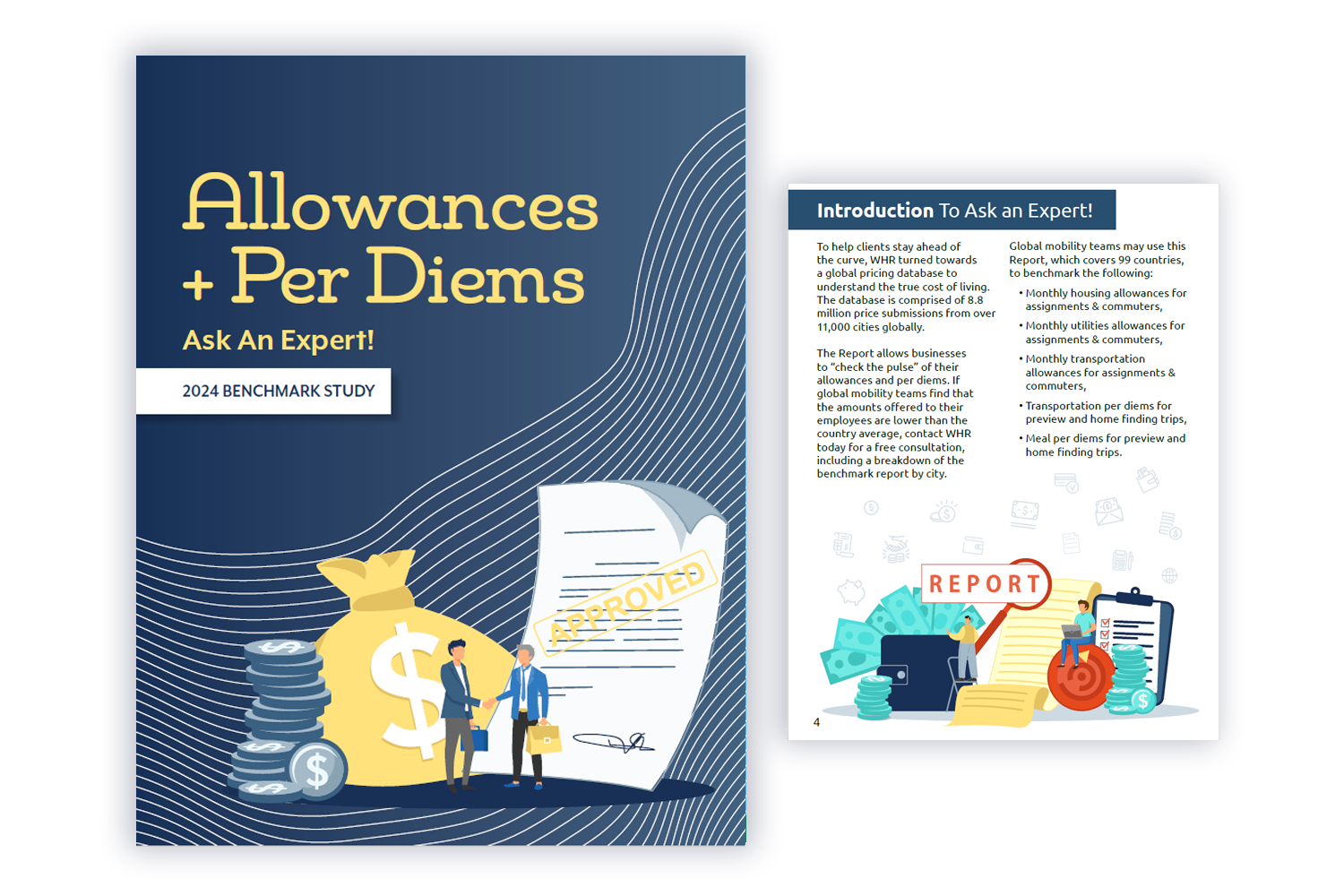
Global mobility teams may use this Report, which covers 99 countries, to benchmark the following: 

    • Monthly housing allowances for assignments & commuters
    • Monthly utilities allowances for assignments & commuters
    • Monthly transportation allowances for assignments & commuters
    • Transportation per diems for preview and home finding trips
    • Meal per diems for preview and home finding trips

Whether you are a relocation manager or a business leader, investing in the Ask an Expert 2024 Allowances & Per Diems Benchmark Report today can help you make the most informed decisions for your relocation budget and employee benefits policies. 

The Benchmark is intended for informational purposes only. 

WHR Global (WHR) is a private, client-driven global relocation management company known for its best-in-class service delivery and cutting-edge, proprietary technology. WHR has offices in the United States, Switzerland, and Singapore, boasting a 100% client retention rate over the past decade. WHR remains a trusted leader in global employee relocation, living by its vision of Advancing Lives Forward® and Making the Complex Simple. 

Contact WHR Global today for more information on global mobility and corporate relocation services, follow us on LinkedIn or download our Global Mobility Benchmark Report 

WHR Global,a leader in global mobility, is an independent, full-service relocation management company with offices in the US, Switzerland, and Singapore. WHR strives to offer cost-effective relocation benefits without compromising empathy, ethics, or service

Ready to learn more about our move management services?

U.S. Domestic Relocation Cost Estimator

US Domestic Relocation Cost Estimator Icon

Interactive Repayment Agreement

Interactive Repayment Agreement Icon

Domestic Relocation Policy Designer

Domestic Relocation-Policy Designer icon

Relocation Benchmark Comparison

Relocation Benchmark Comparison icon

RFP – Relocation Request for Proposal Generator

Relocation Request for Proposal Generator

U.S. Domestic Relocation Policy Essentials

A well-crafted domestic employee relocation policy will improve the transferee experience, control costs, meet your employees’ needs, and help you win and retain new talent. Improving the employee experience means reducing stress so that employees can focus on work roles in their new locations.

Offering a comprehensive suite of relocation services is crucial in crafting a relocation policy that effectively benefits both the company and the employee. A holistic approach not only supports employees in managing the complexities of relocating but also streamlines the process for the company, helping to maintain productivity and reduce the administrative burden.

Regularly reviewing and updating the policy to reflect current market trends and cost-of-living adjustments contributes to overall employee satisfaction and ensures competitiveness.

The 8 essential relocation benefits should be a part of your policy strategy:
1) Home Sale Programs
2) Rental Assistance
3) Destination Services
4) Household Goods
5) Lump Sum
6) Cost of Living Assistance (COLA)
7) Policy Exceptions
8) Policy Tiers vs Core Flex Benefits
8.5) Compliance

U.S. Domestic Relocation Policy Essentials

1) Home Sale Programs

Offering a competitive home sale benefit can provide significant advantages to both the company and the relocating employee. By offering a standardized home sale process, companies can ensure a consistent and controlled relocation experience, reducing the risk of dissatisfaction or failed relocations.

Guaranteed Buyout (GBO) or Buyer Value Option (BVO)

  • Offering a GBO can be risky for your organization since it guarantees employees a home sale based on appraisal value,
    but if the home is not sold then your company takes the home into inventory and must resell it.
  • A BVO, on the other hand, significantly minimizes the organizational risks seen with a GBO since your company purchases the employee’s home only after the employee secures an outside buyer.
  • Some companies offer a GBO to their executives and a BVO to non-executives.

GBO

Some policies offer a Guaranteed Buyout Program (GBO), where the company or a third-party relocation service purchases the home if it does not sell within a certain period. This ensures the employee can move without financial strain.

Pros_Green-CheckmarkPros

  • Tax advantage for your company and the employee.
  • Employees are not required to attend closing.
  • Professional appraisers ensure your company is offering a competitive market price.
  • Guaranteed offer expedites the relocation process so that transferee can relocate faster.

Con-Red-CheckmarkCons

  • The company carries the risk of owning and maintaining the home until it is sold.

BVO

With the Buyer Value Option (BVO) program, the employee is responsible for marketing and selling their home on the open market, but once they secure a bona fide offer from a buyer, the company or a third-party relocation service steps in to purchase the home at the agreed-upon price. This approach allows the employee to sell their home at fair market value, while the company handles the closing and resale, streamlining the process and minimizing the employee’s involvement in the transaction after the offer is secured.

Pros_Green-CheckmarkPros

  • Tax advantage for your company & transferee.
  • Employees are not required to attend closing.
  • Minimizes company costs as buyer is secured by employee.
  • Broker Market Analysis completed by two real estate agents to establish an appropriate marketing parameter.

Con-Red-CheckmarkCons

  • If home sale falls through, homes go into corporate owned inventory.
  • Employees remain financially responsible for their home until an outside offer is accepted which might delay their move to the new work location.

DR

A Direct Reimbursement (DR) home sale benefit offers a flexible, cost-effective alternative to BVO and GBO programs, providing employees with the opportunity to sell their home independently while receiving financial support for key expenses such as real estate agent commissions, closing costs, and legal fees.

Pros_Green-CheckmarkPros

  • Lower financial risk since your company does not have to bring unsold homes into inventory and employees are responsible for selling their home and paying closing costs/commission fees up front.

Con-Red-CheckmarkCons

  • No tax benefit for your company or the employee.
  • Your company will incur additional gross up cost (assuming you offer gross up).
  • Employee is responsible for all costs up front (closing costs, commission fees, inspections, etc.).

Home Sale Bonus

A home sale bonus can be an incentive for employees to sell their homes quickly.

    • Beneficial to your company if you offer a GBO; offered less in a BVO program.
    • Decide where you will cap this benefit, and if the cap will vary dependent on employee’s role. Many companies base it on a percentage of the sale and/or offer a higher bonus for those that can sell their homes within a desired timeframe.
    • This is not required in today’s real estate market as homes are selling quickly as demand greatly outweighs the supply of available inventory.

Loss on Sale

Some companies offer a loss on sale, whereby the company provides an additional benefit to employees selling their homes for less than the original purchase price.

This benefit is more prevalent with executives versus non-executives (usually at a capped amount).

Home Inspections

Most companies require a full home inspection for a GBO and BVO program. The home inspection is ordered by the Relocation Management Company (RMC).

An inspection helps reduce risks of the company purchasing a home with unknown significant defects.

The transferee is required to complete all necessary repairs before moving forward in a BVO or GBO program.

Some companies want to avoid being too picky about required repairs, so an alternative to a full home inspection would be a major component inspection.

Specialized home inspections may include:

  • Well
  • Septic
  • Radon
  • Termite
  • Stucco

If there are suspected issues in other areas, additional inspections might be ordered:

  • HVAC
  • Roof
  • Interior plumbing and/or electrical
  • Structural/foundation

2) Rental Assistance

Employees at different life stages have varied housing needs. Rental assistance benefits ensure that the company’s relocation policy is inclusive and supportive of diverse situations, such as younger employees or those relocating to urban areas where renting is more common.

Additionally, providing rental assistance helps minimize the stress of moving and eases the transition into the new work role. An essential component of this benefit is helping transferees with early lease termination.

If you choose to offer rental assistance, consider the following:

      • How many days of rental search you want to provide.
      • Placing caps on rental assistance ensures your company is containing costs. If an employee exceeds the cap, decide whether to provide an exception benefit on an individual basis.
      • Encourage employees to negotiate with landlords to insert a diplomatic clause into the lease that reduces future lease break fees.
Employee Relocation rental assistance

3) Destination Services

Relocating to a new location can be an overwhelming experience for employees. Destination services play a crucial role in easing this transition by providing support that helps employees settle in more quickly and comfortably. Essential destination services include temporary housing, home-finding assistance, settling in services, among others.

By offering comprehensive destination services, companies can significantly reduce the stress associated with relocation, allowing employees to focus on their new role and become productive sooner. A well-supported transition not only enhances the employee’s experience but also contributes to their overall satisfaction and success in their new position.

Essential destination services for a US Domestic relocation include: Home Finding including temporary housing or house hunting trips and destination closing costs.

Destination Services include house hunting, temporary housing, and destination closing costs

Temporary Housing

Relocating to a new location can be an overwhelming experience for employees. Destination services play a crucial role in easing this transition by providing support that helps employees settle in more quickly and comfortably. Essential destination services include temporary housing, home-finding assistance, settling in services, among others.

By offering comprehensive destination services, companies can significantly reduce the stress associated with relocation, allowing employees to focus on their new role and become productive sooner.

A well-supported transition not only enhances the employee’s experience but also contributes to their overall satisfaction and success in their new position.

Home Finding/ House Hunting Trip

Providing a travel lump sum will simplify the process and allow employees to book/pay for house hunting trips.

See below for more details on lump sums

Destination Closing Costs

Many companies will offer this reimbursement to executives versus non-executives.

  • Capping support is a way to control costs for this taxable benefit, especially if your company is providing gross up. This could be especially helpful when moving employees to high-cost housing destinations.
  • Only allowing reimbursement of typical closing costs is recommended to ensure your company is not reimbursing items that are non-standard.

Some employers offer closing cost assistance to current renters buying a home in their new location.

  • If you decide to provide this benefit, decide who will qualify. Only new-hire or existing employees, only executives or based on job level?
  • Although it is not the most commonly offered benefit, an incentive to rent can provide your company with potential cost savings on future relocations.
  • Good option for employees who relocate often, thereby your company can forego paying closing and future home sale costs on a repetitive basis for the same employee.

4) Household Goods

The HHG move is one of the most stressful stages of a relocation. Covering the cost and logistics of household goods shipping significantly reduces this stress, helping employees focus on transitioning to their new role.

    • Make sure your RMC is proactive in their communications and provides opportunities for employees to give live feedback so that any issues can be addressed immediately.
    • Verify that the RMC provides transparent pricing, detailed tracking of expenses, and comprehensive insurance coverage to mitigate risks.
    • Most companies will provide tax assistance with HHG moves, especially since the Tax Cuts and Jobs Act (TCJA) of 2018 was passed.
Household Goods Shipment

Vehicle Shipment

Create cost savings by basing the number of vehicles authorized on move distance. It is common for companies to offer at least one vehicle to be shipped if the distance will be over 500 miles, and up to two if the distance is over 1000 miles. This reduces the stress of requiring the employee and family to travel long distances in separate vehicles.

Temporary Storage

Most companies will provide temporary storage of the employee’s household goods until permanent housing is secured.

  • A well-defined policy that includes temporary storage provides clear guidelines for both the employee and the company, reducing ambiguity and potential disputes over what is covered during the relocation process.
  • To save costs, do not provide this benefit for personal reasons, e.g., during home remodeling, when the employee may want to store items until the work is complete, or if the employee is going on vacation and cannot be present for HHG delivery.

5) Lump Sum

Lump sum benefits include the freedom of being able to use their relocation money as they see fit

Decide if you want to offer a partial or full lump sum policy to transferees. Some employees may enjoy the freedom of being able to use their relocation money as they see fit.

Pros for providing lump sums include the following:

    • Cost containment
    • Easy budgeting and administration
    • Market competitiveness
    • Great for employees with less to move
    • Internship programs

There are three main types of lump sums discussed below:
lump sum only (no counseling); managed lump sum (with counseling); and lump sum (in addition to other benefits).

Lump Sum Only Benefit
(no counseling)

The transferee receives one lump sum payment. The employee decides how they plan to spend these funds.

  • Commonly used with non-executives including entry-level hires and employees in development programs who rotate locations frequently.
  • Typically, not utilized with higher-level relocations.
  • Majority of lump sums are less than $5K

Managed Lump Sum
(with counseling)

Allows your company to retain partial control over how the employee uses the money while still allowing some flexibility. The RMC counsels the employee on approved ways they can use their managed lump sum, and the funds are provided as a reimbursement after the employee incurs the cost or is direct billed to one of your RMC’s supplier partners.

  • Managed lump sums are used more often as the only benefit to executives or higher-level employees versus a lump sum only (no counseling), used more often with entry-level employees.

Lump Sum
(in addition other benefits)

This is the most frequently used type of lump sum benefit. It works well because companies can provide other benefits – tailored to the individual’s specific relocation needs – while still providing a lump sum that the employee can spend as they wish.

This type of benefit will also allow your company to control costs, and it adds some additional flexibility for the employee.

Cost of Living Adjustment (COLA)

Some of your employees may be moving to an area with a lower cost of living and some may be moving to a much higher cost destination. If higher costs exist, some companies will provide a limited term cost of living allowance to bridge the financial gap. Options for payout could include monthly, quarterly, annually or a one-time lump sum.

  • Set an ending time-period for this benefit and decide whether the benefit will slowly decrease/taper during that time-period.
  • Companies should also consider the tax implications of COLA payments and ensure clear communication with employees about how the adjustment is determined.

It is best to only offer this benefit to those employees moving to higher cost destinations. If your employee is moving from one high cost of living area to another, consider withholding this benefit. Often employers will establish a threshold (typically a percentage), to offer the benefit. Others will identify specific areas/cities and only offer the benefit to employees moving to these pre-determined locations.

Cost of Living Adjustments COLA

7) Policy Exceptions

Decide how you want to handle policy exceptions and make sure you and your RMC are in sync. Develop a well-defined process for requesting and evaluating exceptions, including who is authorized to approve them and under what circumstances exceptions will be considered. Even though you may have a great employee relocation policy, it is not always one-size-fits-all! Individual cultures, specific needs and family dynamics may create the need for exceptions. Make sure your RMC is tracking all requests/outcomes. Regularly review the types and frequency of exceptions requested to identify patterns or gaps in the current policy, which may indicate the need for policy adjustments.

Some common policy exception requests might include the following:

  • Extended temporary housing or household goods storage
  • Additional crating of items, vehicles to be shipped or other services for a household goods move
  • Home listing parameters / Qualifying home requirements
  • Additional reimbursements for travel
  • Repair Requirements
  • Benefit extensions

8) Policy Tiers vs Core Benefits

Policy Tiers

With policy tiers, the company selects which employees receive specific benefit packages. Often, policy tiers categorize employees into different levels (tiers) based on factors like job level, seniority, or relocation distance, with each tier offering a predefined set of benefits.

For example, relocation benefits provided to an executive might be different than benefits provided to an entry-level employee. While a tiered policy allows a company to be selective regarding which benefits are offered to each level of employee, some benefits may be offered in all packages.

In other words, a HHG move could be offered to all relocating employees, but the cost of the move could have caps for lower-level employees. Some companies will only offer home sale assistance to higher level employees, but all other benefits may be the same regardless of role/job level of the employee.

In addition to employee position level, other factors that could affect which tier an employee fits into might include whether they are a homeowner versus renter, or a new hire versus an existing employee.


Core Benefits

Core Flex benefits offer a more tailored solution by providing a core set of essential relocation benefits to all employees while allowing additional flexible benefits that employees can choose based on their specific circumstances.

While Core Flex offers greater customization and can enhance employee satisfaction, it requires more complex administration and careful communication to ensure employees understand their options.

8.5) Compliance

Compliance is an essential consideration when developing a U.S. domestic relocation policy, as it ensures that the company adheres to all relevant laws and regulations. This includes understanding tax implications, employment laws, and real estate practices that vary by state. Creating a policy that prioritizes compliance helps mitigate risks, avoid potential legal issues, and ensures that both the company and the transferee are protected.

In Conclusion

In crafting an effective US domestic relocation policy, it is crucial to consider a variety of best practices that address both employee needs and organizational goals. Regularly compare your policy with industry standards and competitors to ensure it remains competitive and effective.

Consider partnering with a good RMC who can help write your policy, benchmark it regularly, and administer it cost-effectively.

For more best practices, get our 2024 Global Mobility Benchmark Report.

WHR Global,a leader in global mobility, is an independent, full-service relocation management company with offices in the US, Switzerland, and Singapore. WHR strives to offer cost-effective relocation benefits without compromising empathy, ethics, or service

Buyer Value Option (BVO) vs Guaranteed Buyout (GBO) Home Sale Programs. How Do they Compare?

In the realm of corporate relocation, home sale assistance programs play a crucial role in easing the transition for employees and companies alike.

Among the relocation home sale programs, the most popular options are the Buyer Value Option (BVO) and the Guaranteed Buyout Option (GBO) programs.

Each option offering distinct advantages tailored to different needs, our blog will review:

BVO vs GBO Home Sale Benefit home sale with contract

Buyer Value Option
(BVO)

In a Buyer Value Option program (BVO), the employee is responsible for listing their home for sale, with marketing assistance from the Relocation Management Company (RMC). The employee must secure an outside buyer willing to purchase the home at a fair market value. A buyer value option program provides all the tax benefits to the employer and employee, but it depends on the employee securing an outside buyer. The employee is funded their equity, if the contract is deemed valid, based on the outside offer amount. The RMC closes the sale with the buyer at a future date. In a BVO home sale scenario, home appraisals are never ordered.

Buyer value options are a good way for an employee to oversee the entire process and ensure the best fit for their home. The risk of the home sale falling through falls onto the employee in this home sale option.

Guaranteed Buyout Option
(GBO)

What is a Guaranteed Buyout (GBO) program and how does it differ from a Buyer Value Option (BVO)?

Under a GBO program, the RMC orders two home appraisals and then averages the two to determine a guaranteed offer, with a fixed acceptance period. If the employee cannot sell their home on their own, the employer takes the home into inventory. The employer must maintain it until the company can resell it. This carries potential risks and additional costs for an employer.

A BVO home sale, on the other hand, minimizes this risk since the employer only purchases the home after the employee has secured an outside buyer. BVO and GBO home sale programs provide tax benefits to the employer and employee.

BVO Home Sale versus GBO Home Sale

When comparing the two, the choice between BVO and GBO depends largely on the company’s risk tolerance, market conditions, and the level of support they wish to provide to their employees.

BVO programs are cost-effective for companies but can place additional burdens on employees, making them more suitable for strong housing markets.

Conversely, GBO programs, while more expensive, offer greater assurance to employees, making them a preferred choice in uncertain markets or when a company prioritizes employee satisfaction and seamless relocations.

Relocation Home Sale Comparison reviews Buyer Value Option versus Guarantee Buyout Option

Here’s a side-by-side comparison of Buyer Value Option (BVO) and Guaranteed Buyout Option (GBO) home sale programs

Program Structure
Risk to Employee
Risk to Company
Home Sale Timeline
Employee Involvement
Financial Considerations
Market Impact
Flexibility
Appeal to Employees
Usage
Buyer Value Option (BVO)
Employee secures an outside buyer before the company purchases the home
Low risk if the home is sold quickly; however, the employee bears the risk if the market is slow
Lower financial risk since the company only purchases the home after an offer is secured
Typically, longer as the employee must find a buyer before the company purchase
High, as the employee is responsible for marketing and negotiating the sale of their home
Costs are generally lower for the company, but the process can be more stressful for the employee
The success of the BVO depends heavily on the current housing market
More flexible for companies that prefer to minimize upfront financial commitment
May be less attractive to employees due to potential delays and uncertainties
Preferred in stable or strong housing markets where homes are likely to sell quickly
Guaranteed Buyout Option (GBO)
Company provides a guaranteed buyout offer to the employee before listing
No risk to the employee as the company guarantees a buyout, regardless of market conditions
Higher financial risk for the company as they commit to buying the home regardless of market conditions
Generally faster, as the company buys the home directly if it doesn't sell within a set period
Lower, as the company takes over the home sale process after providing the buyout offer
Higher costs for the company due to the guaranteed purchase but provides more certainty and support for the employee
The GBO is less impacted by market conditions as the company assumes the risk
Less flexible due to the company’s financial commitment but provides more stability for employees
Generally, more appealing to employees due to the certainty and reduced personal risk
Often used in slower or volatile markets where securing a buyer may be difficult

Our countless years of BVO and GBO Home Sales experience can help you better navigate your journey.

This can include the range of tax implications, relocation variables, benefit payouts/amounts, and marketing work.

Let the experts at WHR Global help you with your BVO or GBO home sale relocation
and other global mobility program needs

WHR Global,a leader in global mobility, is an independent, full-service relocation management company with offices in the US, Switzerland, and Singapore. WHR strives to offer cost-effective relocation benefits without compromising empathy, ethics, or service

U.S. Domestic Relocation Cost Estimator

US Domestic Relocation Cost Estimator Icon

Interactive Repayment Agreement

Interactive Repayment Agreement Icon

Domestic Relocation Policy Designer

Domestic Relocation-Policy Designer icon

Relocation Benchmark Comparison

Relocation Benchmark Comparison icon

RFP – Relocation Request for Proposal Generator

Relocation Request for Proposal Generator

The Best Types of Expatriate Assignments for Your Mobility Program

Finding the right person for an open position can be challenging, especially in today’s job market. Offering international assignments can be a powerful tool for retaining (and attracting) top talent.

Employees who are given the opportunity to work abroad feel more valued and motivated, leading to higher levels of engagement and loyalty.  Additionally, international assignments can be seen as a prestigious career move, which can attract high-caliber candidates and enhance the company’s reputation as an employer of choice.

The complexities of an international move have intensified in recent years.  Beyond offering a pay raise, covering relocation expenses, or finding them an incredible new home, it is crucial to address the broader needs of expatriates and their families.

In today’s dynamic work environment, assignments can quickly go off course if not managed with a focus on flexibility, cultural integration, and the overall well-being of the employee. 

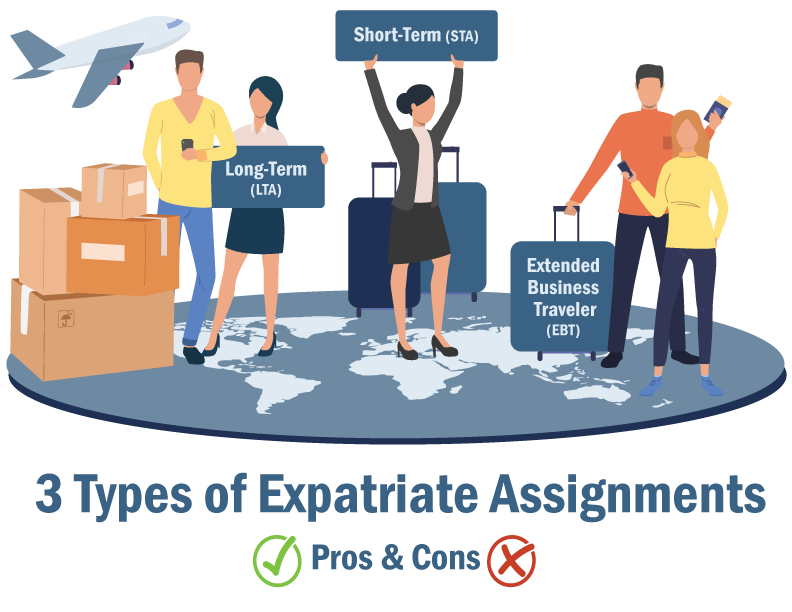
A lot of preparation and planning goes into sending your employees abroad, which is why it is important to understand the advantages and disadvantages of the most common types of expat assignments: long-term, short-term, and extended business travel.

Pros and Cons of the 3 Types of Expatriate Assignments including Long Term, Short Term and Extended Business Traveler

Some companies may choose to use just one type of assignment or include multiple different options, depending on the employee and the position available. Either way, finding the best expat program for both your company and your employee will ensure both are successful long term.

Long-Term Expat Assignment (LTA)

A long-term assignment (LTA) refers to the relocation of an employee from their home country to work in a foreign country for an extended period, typically ranging from one to five years or more.  Unlike short-term assignments (STA’s), which might last only a few months, LTAs involve a deeper commitment and often require significant personal and professional adjustments for the expat employee.

During an LTA, the employee is expected to fully integrate into the local work environment, often taking on key roles that contribute to the company’s strategic goals in the host country.  This could include tasks like establishing new operations, leading a local team, implementing corporate strategies, or facilitating knowledge transfer between the home and host offices.

One of the most important things to note is that this type of assignment is not a permanent transfer; the employee intends to return to his or her home country after the long-term assignment is complete.

Long Term Assignment container shipment of household goods

Pros_Green-CheckmarkPros of a Long-Term Expat Assignment

LTAs provide a unique opportunity for employees to develop leadership skills in a global context.

By exposing them to different markets, cultures, and business practices, companies can groom future leaders who are adaptable, culturally aware, and capable of managing diverse teams. These global experiences are invaluable for shaping executives who can drive the company’s international strategy.

Expat employees often serve as a vital link between the headquarters and the host country’s office, ensuring that the company’s global strategies are effectively implemented at the local level. In the past, it was important to instill the culture of the parent company into the foreign entity and help drive revenue growth in the overseas location.

Today this still exists, but the opposite is also true. Overseas workers are being deployed to the parent country or other countries to gain experience, transfer knowledge, and run specific project-based work.


Con-Red-Checkmark Cons of a Long-Term Expat Assignment

One of the biggest challenges of long-term expatriate assignments is the potential strain on personal and family life. Relocating to a foreign country can disrupt children’s education, create challenges for a spouse’s career, and lead to feelings of isolation due to cultural differences and distance from extended family and friends.

Not all LTAs succeed. If an expat employee fails to adapt to the new environment or if personal issues arise, the assignment may need to be cut short, leading to significant costs. Costs are extremely high for expat assignments and many companies do not properly vet the individual being offered the assignment.

There are benefits available including candidate assessments and pre-decision services that are designed to assess the person’s ability to thrive in a “foreign” location and adapt culturally.  Additionally, many companies forego cultural and language training which is essential in providing a foundation for a successful transition.  Simple things like how to conduct a business meeting or learning the norms for handing out a business card are just some of the subtle social norms that will ensure success. Unfortunately, many companies choose not to or do not know the importance of this investment.

There are countless compliance requirements as well, and without the assistance of a relocation company, it can be hard to navigate. Many companies have chosen another route: short-term expat assignments.


Short-Term Expat Assignment (STA)

A short-term assignment (STA) typically refers to a temporary work arrangement where an employee is relocated to a foreign country for a limited period, usually ranging from a few months to a year.  Unlike long-term assignments (LTAs), which often involve significant life adjustments such as family relocation and long-term planning, STAs are more focused on specific projects, skill development, or filling immediate business needs.  STA’s can offer great flexibility and less commitment, but less fluidity and insurance.

Many companies will not allow the family to accompany the employee on these STAs but will provide other options such as more frequent trips home, furnished accommodations, per diems, travel allowances, etc.

Relocation management companies like WHR Global, can help manage short-term expatriates and provide the structure and benefits available to this group of assignees.

Short Term expat assignment with small shipment of items

Pros_Green-Checkmark Pros of a Short-Term Expat Assignment

The problems of dissatisfaction and homesickness became apparent with long-term moves, so short-term overseas engagements were developed as an alternative to pulling up roots and moving families across the globe for extended periods. Short-term assignments involve fewer personal and professional disruptions for employees. Family members often remain in the home country, minimizing the impact on schooling, careers, and social networks.

From your company’s perspective, a short duration generally costs less upfront, and it gives you more flexibility when developing a mobile, global workforce. Additionally, the consequences of individuals becoming “taxable” in the foreign location can be managed effectively, thus significantly decreasing the cost of the expat assignment.

Lastly, the pool of willing candidates inevitably increases as it is a short-term expat assignment, which reduces the potential impact on families and financial ramifications.

Con-Red-Checkmark Cons of a Short-Term Expat Assignment

The cons of short-term expatriate assignments revolve around demands to rotate a variety of personnel, which requires more planning and administrative time for everyone involved.

There is a trade-off between a series of short-term assignments versus a single long-term assignment.  What works for your company may not work well for others.

These assignments allow companies to leverage global talent efficiently while providing employees with international exposure and professional growth opportunities without the extended commitment of a permanent move.

Extended Business Traveler (EBT)

An Extended Business Traveler (EBT) program is a structured framework designed to manage employees who frequently travel internationally for business over extended periods, typically ranging from a few weeks to a few months.

Unlike traditional expatriate assignments, EBT programs cater to employees who remain officially based in their home country but spend significant time working in foreign locations. These programs are increasingly popular in global companies as they allow for flexibility and quick deployment of talent across borders without the need for full relocation.

Typically, these employees are not on a formal assignment; however, there are still potential tax and immigration considerations that need to be made when sending someone on these extended business trips.

Extended business traveler

Pro_Green-Checkmark Pros of an Extended Business Traveler

EBT programs allow companies to deploy talent quickly and efficiently across multiple locations without committing to long-term relocations. This flexibility is ideal for addressing short-term business needs, project launches, or client demands. For everyone involved, business traveling simply causes less disruption.

Your workforce has much more control over how they perform duties, and you do not have to permanently allocate resources to a foreign location.

Con-Red-Checkmark Cons of an Extended Business Traveler

Work visa requirements differ widely from country to country and can be impacted by the home and host locations involved.

In some instances, a worker may enter the country on a work permit waiver, but in other countries it may be illegal to perform a single work duty without having the proper work visas in place.

Conclusion

How companies manage expat assignments has changed in this post pandemic world. Ever changing immigration policies, unpredictable travel restrictions, and increased costs make managing these assignments more challenging than ever before.

Regardless of the assignment type that is considered, each type of expatriate assignment has its strengths and pitfalls. Every company needs to determine what is optimal for their workforce and the business needs requiring these assignments. Let the experts at WHR Global help guide your employees and company through these types of decisions and implementations.

Ready to learn about our move management services?

U.S. Domestic Relocation Cost Estimator

US Domestic Relocation Cost Estimator Icon

Interactive Repayment Agreement

Interactive Repayment Agreement Icon

Domestic Relocation Policy Designer

Domestic Relocation-Policy Designer icon

Relocation Benchmark Comparison

Relocation Benchmark Comparison icon

RFP – Relocation Request for Proposal Generator

Relocation Request for Proposal Generator

What is a Buyer Value Option (BVO) Home Sale Program?

A BVO home sale program is a program which is designed to help relocating employees sell their homes quickly and efficiently without the company taking ownership of the property.

According to WHR’s 2024 Global Mobility Benchmark, a BVO program remains one of the most competitive relocation offerings.

  • 60% of respondents offer home sale and/or purchase benefits.
    • Of those,
      • 59% offer BVOs to new hire non-executives
      • 78% offer BVOs to new hire executives
      • 67% offer BVOs to existing employee non-executives
      • 74% offer BVOs to existing employee executives

The best way to describe a BVO is in the context of
a traditional Guaranteed Buyout (GBO) program

Under a GBO, the relocation management company (RMC) orders two home appraisals and simply averages the two to determine a guaranteed offer.
As an example:

  • Appraiser A values a relocating employee’s home at $330,000
  • Appraiser B values the same home at $335,000
  • $332,500 is considered the “GBO”

The relocating employee then takes the offer of $332,500 and moves to their new location, unencumbered by their former home. In turn, the RMC sells the property on the
open market, and the employer is charged for all of the associated real estate expenses upon the conclusion of the sale.

The employer can treat the home sale costs as “business expenses,” so none of the expenses are considered income to the employee (for federal tax purposes).
This process is validated by the IRS in Revenue Ruling (2005-74), which specifically addresses this type of home sale program.

What is a Buyer Value Option (BVO)?

Essentially, BVO is very similar to a GBO, with the exception that with a BVO home sale program, no appraisals are completed. Instead, the buyout offer is based on a bona fide fair market offer received by the employee from a qualified third-party buyer. With BVO, the employee is responsible for listing their home for sale, and receives marketing assistance from the RMC.  

Once a contract is deemed valid, the RMC offers to buy the home from the employee at a price based on the outside sale price, and the employee is funded their equity based on this amount. The RMC will enter into a new listing agreement with the employee’s broker and proceed to close the transaction with the outside buyer while honoring all agreed terms and conditions. All home sale costs are treated in the same manner as with a GBO program.  

The BVO home sale program provides all the tax benefits to both the employer and employee. However, it is the responsibility of the employee to secure an outside buyer ready, willing, and able to purchase the property at a fair market value. 

Why should you offer your relocating employees a BVO?

    • Tax Savings: A properly structured BVO program that adheres to IRS requirements provides significant tax savings that benefit employees as well as employers.
    • Minimized Risk for Employees: Employees avoid the financial risk and stress of carrying two mortgages if they have to move before their home is sold.
    • Expedited Relocation: Employees can move to their new location more quickly, knowing that their home sale is being managed.
    • Cost Efficiency for Employers: Employers can manage relocation costs more effectively and help maintain employee productivity by reducing the stress and financial burden associated with home selling.

WHR Global provides the following
BVO support to help your employee
sell the home to an outside buyer:

    • Obtain two Broker Price Opinions (Broker Market Analyses)
    • Reconcile the two opinions of value
    • Suggest a listing price
    • Develop a comprehensive marketing strategy
    • Obtain pictures of the home
    • Provide tips to paint, declutter, etc.
    • Assist with Realtor selection
    • Obtain weekly feedback from Realtor
    • Assist in contract negotiation

Be aware: From a cost standpoint, when selling a home, the following expenditures are typical in a home sale transaction. 

When selling a home, there are several expenditures in a typical home sale transaction
  • Real Estate Commissions
  • Recording Fees
  • Transfer Taxes
  • Title Expenses
  • Notary
  • Escrow Fees
  • Seller Concessions
  • Repairs
  • Inspections
  • Miscellaneous

A Buyer Value Option home sale program is a valuable tool for companies looking to support their relocating employees. By assisting with the home sale process, companies can alleviate a significant source of stress for their employees, ensuring a smoother transition and enhancing overall job satisfaction.

For the company, this can translate into higher retention rates, more successful relocations, and a stronger ability to attract top talent. 

Ready to learn more about our move management services?

U.S. Domestic Relocation Cost Estimator

US Domestic Relocation Cost Estimator Icon

Interactive Repayment Agreement

Interactive Repayment Agreement Icon

Domestic Relocation Policy Designer

Domestic Relocation-Policy Designer icon

Relocation Benchmark Comparison

Relocation Benchmark Comparison icon

RFP – Relocation Request for Proposal Generator

Relocation Request for Proposal Generator