Role of relocation management companies in the new era of talent mobility

Talent mobility has increased in this new era of technological and industrial development. Thus, there are situations where the company must relocate their employees to another place or company, also called global mobility. This can happen for various reasons. One of these reasons could be the need for an employee’s talent in a particular company’s domain to help improve the company as a whole. But this process is time-consuming and costly for many businesses. This is the point where relocation management companies play a vital role. This business helps other companies shift or relocate their employees by providing them with faster and more affordable solutions. To learn more about relocation management companies, we encourage you to continue reading.

What are the reasons for employee relocation?

Relocation stands as an important benefit for both employees as well as the company. When you shift talent from one place to another, where it is most in need, both the employee and company can benefit and prosper from this change. The employee gains new experiences and the company is able to share the knowledge that this particular employee can hold with others who want to learn and grow.  Relocation could also be due to a development program that will be profitable for the company that the employee works for. Sharing knowledge can help the company’s growth in other locations, by learning from this employee relocation.

Many companies may transfer their knowledgeable employees from one location to another where there is a need of sharing a few important skills which would help the companies upskill others. A company can also do this to ensure the proper working condition of other branches of the company or locations. Thus, there are many advantages both for the employee as well as the company by the process of relocation. This process becomes easier when a relocation management company is involved. They make the work much faster and at an affordable cost.


Why is it difficult without relocation management companies?

It is a complex process because the relocation of an employee involves:

  • Buying a new home.
  • Renting an apartment.
  • Moving goods from the present to the new place.

Moreover, if the employee has a family and children, it is not easy to find a school and adapt to the new condition. International relocation involves the knowledge gained about rules and language for the employee. It takes an enormous amount of time when all these processes are done by the employee himself or herself. During this change, it can reduce the company’s productivity at the particular new location due to the delay in the talent shift. All these of these mishaps can be avoided and done in a short span of time with the relocation management companies.


Minimizes the time taken for such processes

It is recommended to go with a relocation management company for talent mobility because it is not easy for an employee to deal with relocation, if they have never been exposed to it before. The relocation management companies help the employees and corporations by taking care of relocation processes before and after it is done. Thus, the employee doesn’t have to waste their quality time and step back from their work by involving themselves wholly in the relocation process. It can also be stressful for an employee to handle both work and relocation at the same time, decreasing productivity.


RMC makes it easy for both employee and HR department

It is usually the Human resource management that helps and supports the relocation of an employee. The department ensures that the relocation is consistent and made in a way that does not cause any productivity loss for the company. For an employee, relocation is stressful until they are provided with a helping hand. This is where the relocation management companies provide you with the assistance you need. This aid would be much needed when it is an international relocation. These kinds of international relocations are not easy, but there are so many processes that have to be followed to ensure that there are no problems in the future.

When an employee is relocating internationally, he or she might already have stress about adapting to the new culture, environment, and other big life changes. Thus, having a relocation management company will be of great use and help them in this adjustment period. In addition, having a contract with trusted and professional relocating companies can help the work be done faster and effectively because they have a good network with relocation experts in their hand.


Concatenation of expert relocators

Expert RMCs have a strong network of trusted partners including household goods movers, real estate firms, temporary housing providers, cross-cultural trainers, and other experts who help in the employee relocation process. These partners and networks work jointly and ensure a smooth relocation process before and during the relocation of an employee from one place to another. 

Overcoming Common Employee Relocation Concerns

Making a major life changing decision is not easy, especially when it involves moving across the country or globe! Even the most excited employees may have concerns about the relocation process. Frequent communication is paramount to a successful relocation for both the employee and your organization. By anticipating and recognizing employee concerns, you’ll be prepared to alleviate their worries and keep relocations moving smoothly. Below are some common employee relocation concerns and how you can help.

Concerns About Finding a Place to Live in the Destination
With U.S. home inventory currently well below demand, it’s not unusual for double-digit offers, many well over asking price on the same or next day after the home hits the market! There’s a chance your employee could sell their home so quickly and then not have a new home to move into at the new location. It’s important to give your employees the time and resources they need to find a new home and complete the move.

  • Your Relocation Management Company (RMC) should provide qualified real estate agents that understand the relocation process and the timelines associated with such moves.
  • If you need your employee in the new location immediately, offer them temporary corporate housing so they’ll rest assured while they continue their new home search.

Concerns About Their Family & Acclimating to the New Location

Family can be a top reason that employees decline a relocation. Employees and their families may have obligations they must fulfill before moving. They might want their children to finish out the school year, have an ill family member or have a partner with their own career pursuits. Moving is stressful, but not knowing anyone in the new location makes it even more challenging. Kids especially find it difficult to move from friends, family and school. Your employee and their family have built a well-established network – from their favorite grocery store to their gym, and it’s difficult to leave all that behind. Your employee cannot 100% focus on their new position when they are preoccupied with their family’s needs.

When you take the family’s needs into consideration, you are showing your employee you truly care about making this a positive experience for them. Anything that you can do to show that you care about their personal life will go a long way to ease their stress and concerns.

  • It’s essential that you communicate timelines and expectations with the employee. By regularly discussing organizational needs and understanding each individual employee’s circumstances, you greatly increase the chances of retaining your top employees.

Destination Services are Crucial to a Successful Move

  • Provide the transferee and family with settling-in services including information on the new city, neighborhoods, medical options, shopping, transportation, utility connections, schools and more.
  • Set up an area orientation to help them get familiarized with their new surroundings.
  • Provide language and cultural training. Help with passports, Visas, work permits and immigration assistance. All especially important for global moves.
  • Offer spousal/partner career assistance to help their significant other find a job in the new location.
  • If the family needs to stay in the old location longer than anticipated, offer the employee temporary housing.
  • Pay for travel expenses to and from the new location.

Concerns About Affording to Live in the New Neighborhood
Packing up and moving from rural Iowa to Manhattan would be a shock to anyone. The cost of living can be drastically different depending on where your employee is moving from and to. The cost of homes, taxes, even groceries may be significantly more than what your employees are used to.

  • Offer your employee a cost-of-living allowance (COLA) that helps ease your employees into the cost of the new location. Many companies choose to taper off these benefits over the course of a few years. You can make the transition to a new city less costly and more affordable for your best employees.

A good RMC will help lesson transferee stress and concerns associated with a relocation. Need help managing employee relocations for your organization? Contact WHR Group, Inc. now.

Colorado Rockies to the Swiss Alps – it’s all coming together

By Jenny Elsby

Its been a couple of weeks since my last post, and its been a busy period!

I managed to move out of my temporary housing, and into my long term house on the outskirts of Basel. Its lovely to no longer hear boy racers, in their BMW’s driving past my window at 1am in the morning with their music blaring, and of course to be living in an area bigger than 30sqm! There are of course down sides too, namely the fact that I now have a 45 minute commute, albeit an easy one with one direct tram, but namely the fact that my apartment is huuuuge, and its empty! When my husband and I decided to move back to Europe, we decided not to ship any of our furniture; knowing that our American size furniture would likely not suit a European apartment. Whilst it has been liberating to sell or donate everything, it is now the reason why I am sleeping on a mattress on the floor (waiting for my husband to arrive to build the bed), and that an IKEA sofa is the only piece of furniture in my living room. Curtains, TV’s, Dining Tables, and other pieces of furniture are all on the shopping list and are going to be assigned to my husband as a “to do” once he arrives.

Speaking of arriving, this is the other exciting part. After 3 long months, the Swiss Authorities finally granted my husband his Swiss visa. The canton where I lived sent me approval my email, which I then sent to my husband. He sent this together with his passport to the Swiss Consulate in San Francisco, and they issued his visa, hurray!!!!

We have only been apart 3 months but it has felt like a very long time, and although we have been preparing for the move for a year, now it’s starting to get real! Until this point for him, it was always something that would happen in the future, and now with his visa in hand, it has started to dawn on him that this is happening! Cue that he needs to start emptying our house, and getting this, and our car ready for sale. This also means getting the logistics finalized for importing our animals; which has always been our priority! Time to follow up with our banks, insurance companies, pet relocation companies, realtor in the US, and more to finalize the move.

On the Swiss end, because of the quarantine requirements for Americans entering the country, I have been stocking up on the food and other items needed to sustain the family for 10 days. Knowing that like many European fridges, my freezer is just about large enough to hold two pizzas and not much else, that does somewhat limit our options. But regardless, I throw myself into stocking up on supplies, to include lots of pasta! I even venture out to the Asian stores in the vicinity of of our offices, where not only do they do a great selection of hot Indian food, but they also sell a good selections of spices, which will make my seasoning loving Louisiana husband very happy.

Time to book my flight, and of course my PCR test!

INTERNATIONAL HR ADVISER (Spring Issue) – Relocating Internationally During COVID-19: Brew City To Lion City, And The Colorado Rockies To The Swiss Alps

Relocating Internationally During COVID-19: Brew City To Lion City, And The Colorado Rockies To The Swiss Alps.

WHR’s Linden Houghtby & Jennifer Elsby speak with International HR Adviser about their experiences relocating during COVID-19.

As Global Mobility professionals, we all know the logistics of moving expatriates from A-B, but none of us have ever faced managing international relocations during a global pandemic. We’d like to share our personal international relocation experiences over the past six months, in hopes that it will offer advice if you are currently relocating your expatriate colleagues during this global pandemic.

Arrival And Quarantine In Singapore

Like so many others planning to move or travel internationally last year, 2020 required us to adapt and adjust our international expansion plans. As a result, my personal and professional move to Singapore was postponed by about six months. Instead of moving in June, I did not arrive in Singapore until the end of December. As you may know, Singapore had enacted strict procedures for allowing travelers into the country to minimize the spread of COVID-19 within the city-state. This includes entry approval requests, PCR testing and mandatory quarantines. Preparing for my flight and the subsequent quarantine was both daunting and stressful, but while there are many requirements, Singapore does have a system in place to make arrival and quarantining a smooth process.

As we know, anytime you are moving your expatriate employees internationally for work, having all necessary documentation in order is crucial, and even more important
now since many additional documents are required. All my documentation was presented and reviewed countless times
from airport check-in, to transfer, to my quarantine hotel.

Once I arrived at my designated quarantine hotel where I would be spending the next 15 days, much of the worry I had regarding the experience dissipated as I was lucky in my hotel assignment. I could put my worst-case scenario fears to rest. I was assigned a room with large windows overlooking the Singapore River, a small desk with a chair, and enough floor space for a yoga mat. Much better than some posts in various Facebook groups led me to expect.

Not that spending 15 days in one hotel room is easy or an experience I look forward to repeating any time soon, but the hotel staff did a phenomenal job taking care of me during my stay. The Wellness staff called daily just to check in and see how I was doing and if I needed anything. The hotel also organised virtual events and activities for those in quarantine including a New Year’s Eve Zoom party; towel folding competitions; Singapore themed crossword puzzle; and exercise/yoga classes.

I know that everyone’s quarantine experience will be different, but here are some tips that helped me through mine:
• Manage your expatriates’ expectations – do not expect a 5-star hotel experience, even if staying at a 5-star hotel
• Take your own cutlery – I do not know why, but having something other than plastic utensils was very nice
• Pack snacks – we were served three meals a day, but it was nice to have some snacks
• Take things to do – books, puzzles, knitting, drawing, whatever you enjoy doing to help pass the time and break up the days
• Be prepared for it to get hard – I compared my stay to a CrossFit workout: the first third is not bad, you are confident and motivated; the second third is painful, and you may want to give up; but the final third gets easier as the end is in sight
• Stay in contact with family and friends – video calls/texting were great distractions from feeling stuck or isolated without any direct human contact in days.

For anyone planning to travel internationally who will be required to quarantine, know that you are in good company and that you can do it! Taking some time to prepare can make a world of difference!

Making It Home

Unpacking my suitcases for the last time and stocking my fridge were relatively small tasks, but doing those things made me feel more grounded and comfortable than I have been since leaving Wisconsin in late October. I did not realize that I was carrying an extra layer of tension or discomfort until it melted away by feeling at home again. The past few months have been an incredible adventure and opportunity. I am very thankful for going to both Switzerland and Singapore for WHR’s international expansion, but it has not been without its challenges. After a while, living in temporary apartments and hotels got wearing and the thought of having to pack and unpack yet again was daunting. These feelings motivated me to secure my long-term housing, truly unpack and get settled. While I knew I was ready to feel less transient and more like I was actually living in Singapore, I did not expect to feel such a difference so quickly upon moving into my new home…

COVID-19 and its Effects on International Household Goods Moves – What You Need to Know!

Virtually every industry has been affected by the global COVID-19 pandemic. International employee relocations and the shipment of household goods (HHG) is not exempt. In fact, this industry continues to face many difficulties. Travel restrictions and quarantine periods have also added extra layers of problems for international transferees. Here we will summarize the challenges affecting international HHG moves, but more importantly, we will offer suggestions to help ease those burdens for both your organization and employees.

The Challenges

Issues facing the international move industry today include rising service costs, longer shipping times, and a shortage of both movers and containers. According to General Manager and Vice President for Paramount Transportation Systems, Brian Goates, “Transit times are totally unreliable and unpredictable, as well as charges.” Due to COVID-19 safety and wellbeing protocols, many changes have been implemented in port locations. Docking, loading, and unloading processes have become much less efficient, causing delays. While ships are waiting to dock and unload, onboard containers are in use.

In the past, those containers had been available to quickly turnover for new shipments. This lack of available containers increases port congestion and decreases the efficiency of docking/unloading. Several international locations have experienced record numbers of ships in port, at anchor and those waiting for a berth spot. Any time spent at anchor and not physically in transit adds time to the overall shipment duration.

Due to these delays, costs have risen. From a simple supply and demand model, these container shortages translate into available containers becoming more valuable, and therefore, more expensive. According to Champion International Moving, Ltd., Director of International Sales, Mike Brandwein, “We are seeing shortages and massive steamship container cost increases. It is also for air shipments. In some regions, costs have increased from $4K to $12K or more, per container.”

Once the containers are finally offloaded into port, there may not be available truck drivers to take the container from port to their respective destinations since the labor pool for drivers has not increased during the pandemic, despite increased demand. As a result, once offloaded the container may need to stay in port longer than usual and incur additional port storage charges.

According to President/CEO of Aaversal Global Relocation, LLC, Hosea Bottley, “Due to COVID-19, equipment is not positioned the way it normally is, so we are running into container shortages at some ports East and West, along with a shortage of truckers. International relocations will have challenges, especially as countries began to open up and more volume is put into the system.”

When the economic shutdowns began in spring of 2020, ports were heavily impacted. Port workers were sent home. This created a backlog of ships trying to get into port for loading or unloading. While most port workers were recalled relatively quickly as essential workers, the domino effect of delays and congestion had already been set in motion. Today, the issues continue. While many port workers have returned, COVID-19 related concerns remain resulting in a smaller labor pool than in the past.

According to a February 2021 Service Alert put out by Paramount Transportation Systems, “COVID-19 supply chain issues are ongoing and causing equipment shortages, sailing delays, import delays and port congestion worldwide. As the ports and shipping lines continue to work through the issues, we are all experiencing unexpected additional expenses. In the United States, there are a number of ports that are refusing to allow containers to be returned. In many cases, the shipping lines are waiving detention charges, but chassis fees are being assessed as the delay ties up equipment. The situation and timing vary, and total costs can only be determined when the container is returned. Oil prices are increasing again, and ocean carriers are preparing to add fuel surcharges to the already sky-high freight rates, surcharges and premium fees.”

Alternative

Air freight shipment is an alternative option to sea transit, even for international moves. While air freight delays have not been as significant, costs for air freight can be higher. Worldwide, the number of available flights has decreased drastically and while the demand for travel has also dwindled, air freight shipments have decreased. As a result, many sea freight shipments have converted to air freight which increases the demand for available space on airlines. This supply and demand scenario has caused air freight costs to increase on a regular basis.

While Goates, Brandwein and Bottley are optimistic these issues would eventually sort themselves out, each felt these challenges could linger for some time.

How to Cope with These Challenges

As the COVID-19 pandemic continues, it’s important to stay abreast of this fluid situation. At WHR Group, Inc. (WHR), we remain hopeful that things will eventually return to normal. In the meantime, we offer some tips to help you get through this tough time:

  • Work with a good Relocation Management Company (RMC) who will help you navigate these challenges.
  • Plan for more shipment time, especially international moves.
  • Change to air freight versus sea freight if feasible and affordable.
  • Be patient, things will get better.

At WHR Group, Inc. (WHR), our Supply Chain Management department builds and maintains relationships with quality network providers. We continue to monitor this ever-changing situation and its impact on household goods moves. Through our extensive and well-vetted supply chain network, we can find the right providers to navigate each employee relocation on a case-by-case basis.

Contact Us

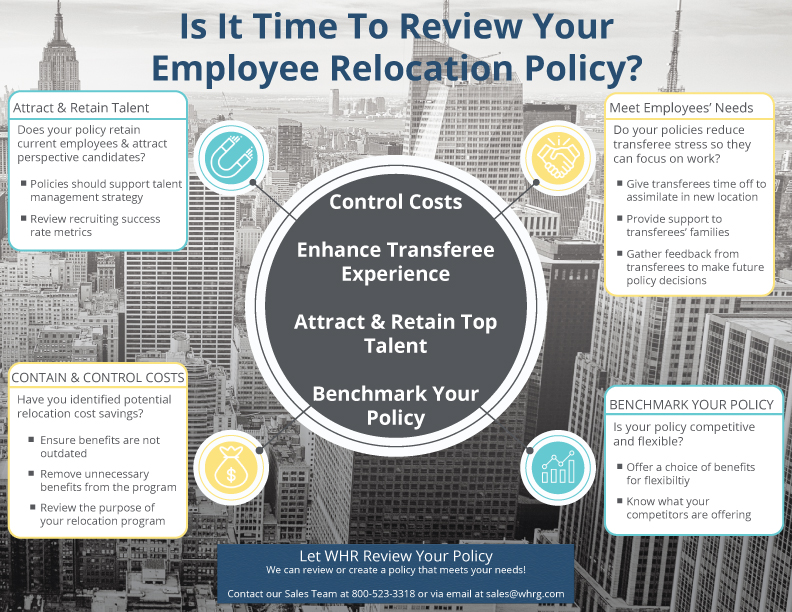
Here’s Why Reviewing Your Relocation Policy is Critical to Your Business

Given the many changes businesses have encountered from COVID-19, including employees working remotely, you might think there’s no reason to review your company’s employee relocation policy right now. Well, think again. Many companies are still relocating employees to fill needed roles. Reviewing your policy and making needed adjustments now can help your organization in the following areas:

Review Your Employee Relocation Policy

The following examples are from policy reviews WHR Global conducted for its clients. These examples demonstrate just how important it is to review your relocation policy on a regular basis.

A. Control Business Costs & Stop Paying for Unnecessary Benefits

Make sure you’re allocating the right amount of dollars to both transferees and organizational needs. It’s also essential that you’re not paying for unnecessary or outdated benefits.

  • Example #1
    A company whose policy we reviewed was giving every transferee a standard $5K-$10K relocation lump sum to assist with any extra expenses. They were also giving executives a lump sum equal to 6 weeks salary on top of the $5K-$10K lump sum. Since some executives had large salaries, this allowance sometimes equated to $50K per executive! After review, we recommended the company cut back on that practice for executives. The company saved hundreds of thousands of dollars.
  • Example #2
    A client was paying a cost of living differential if the employee was relocating to a higher cost area. They were paying this out for 3–4 years, plus they were also providing a big lump sum benefit. We recommended a minimum 5% cost of living threshold so that they were not paying transferees moving to only slightly higher cost of living areas. The client saved millions.
  • Example #3
    Another client was giving out non-promotional bonuses to current employees willing to relocate for a lateral role. These bonuses equated to 5% of the employees’ salaries. Since this practice is not common, we recommended they eliminate this from their relocation policy, which saved them significant costs without lowering the value of their program.
  • Example #4
    One of our clients was paying a loan origination fee. Some lenders don’t even charge this fee, but if they know the client will pay, they will still charge the fee anyway. Once the client realized this, they stopped paying the fee unless necessary.

B. Meet Your Employees’ Needs

It’s important that your relocation policy meets your transferees’ needs. This helps to reduce transferee stress so that employees can focus on work in their new location. Giving transferees time off to assimilate in their new location, providing support to transferees’ families, and gathering post-relocation feedback to make future policy decisions will all help to address your transferees’ needs. 

  • Example #1
    One of our clients was offering a lump sum benefit for all international relocations. By gathering post-relocation survey feedback, we found out transferees were trying to coordinate their own international household goods (HHG) shipments and were not spending the full lump sum, in hopes of keeping some money. The survey feedback also showed that giving employees that level of choice was adding more stress on them, and it was making the relocation process take longer. Basically, transferees were trying to do it all on their own plus pinch pennies. The client considered all key benefits and determined the lump sum was not working. They shifted from a lump sum to a core flex benefit. This meant the client would cover HHG shipments, destination service providers and temporary housing, but they still gave transferees a lump sum amount to be used at the employees’ discretion. Not only did this help reduce transferee stress, but it also helped control business costs.
  • Example #2
    One client was not offering destination services to the spouses/partners and families of intra-European moves. They assumed that if a transferee/family was relocating from Russia to the UK, for example, destination services were not needed. Through post-relocation survey feedback, it was determined that spouses/partners required career assistance, language training and help with school searches for their children. The employee had office workers to help them assimilate in the new locations, but the transferees’ partners were struggling with the new language and even struggling to find necessities like grocery stores. Recognizing the needs of the entire family unit, and not just the transferee, is crucial to ensuring a successful move and assimilation.

C. Attracting/Retaining Talent Plus Benchmarking Your Policy Against the Competition

Hopefully, your relocation policy is already part of your total rewards and talent management strategy. The right policy will help your company retain current employees and attract perspective candidates. A weak relocation policy could have a negative impact on your recruiting success rate.

Benchmarking your policy against other companies will help you stay competitive in the war for talent. Make sure your policy provides a choice of offerings, since relocation policies are wrapped into job offers. If you don’t benchmark against your competitors, you won’t know if your offerings are good or not. Are they subpar to what everyone else is offering? If you are hiring high level executives, for example, and the talent is very specific and not easy to come by, you’ll want to make sure you’re competitive with salary, benefits, and your relocation policy.

At the same time, benchmarking will ensure you’re not giving away too much when none of your competitors are doing that. Benchmarking your policy against others shows you are in line with the industry. It’s also important to not only look at your industry, but also other industries you compete with for talent.

  • Example #1
    Imagine losing a potential candidate because your relocation policy is missing benefits your competitors are including. For example, if your candidate is an executive expecting a full buyout, but your policy only includes a HHG move and lump sum payout, then you have to go back and forth negotiating with your superiors and the candidate. This can waste a lot of time. In the interim, the candidate might receive a better job offer, including more relocation benefits. A relocation policy can be a factor for candidates deciding whether to take one job over another. If you’ve benchmarked your policy against your competition, you’ll already know what their policies include.
  • Example #2
    A client was getting feedback from its talent acquisition team that it was difficult filling certain positions. After reviewing their policy and benchmarking it against their competitors, we discovered that their competition was offering far richer relocation benefits. As a result, the company decided to expand its range of jobs eligible for full relocation benefits.

D. How often should you review your policy?

WHR recommends you review your employee relocation policy annually or every couple of years at the very longest. It does not have to be a huge overhaul, but it’s a chance for you to pause and look at employee feedback. Additionally, you should confirm any changes in your company culture, driving principles, core values, talent strategy, the industry, and your competition. The review is a time for you to make sure your policy is aligned with all of those pieces and your key stakeholders (talent acquisition teams, recruiting teams, HR business partners).

Review Your Policy