Working from Home – Is It the New Permanent Normal and is It Feasible for all Businesses?

Companies worldwide were forced to adapt when the threat of COVID-19 made working from home the new normal. While some company cultures and business models might not support permanent work from home, other companies including Twitter have told employees they can work from home forever.

Working From Home

In-Person Interactions

WHR Group, Inc. (WHR) is one company that believes in-person interaction among coworkers is essential to maintaining its culture. “Personally, I feel it’s really hard to develop a culture on Zoom,” says WHR Founder and CEO, Roger Thrun. “It’s like dating online versus dating in person. Think about catfishing, you don’t really know if someone is pretending to be someone they’re not. Think about authenticity. Nothing beats meeting someone face-to-face and nothing can replace looking that person directly in the eyes.” Thrun believes instilling values and culture is very hard to do digitally. “Our culture is developed by values, and those values are much harder to convey and enforce online.”

The Implications of Working Without an Office,“ article in the Harvard Business Review addresses an all remote workforce, “One key reason to think twice before going down that path is the loss of unplanned interactions that lead to important outcomes. Physical offices cause people who don’t normally work with each other to connect accidentally — bumping into each other in the hallway or the cafeteria — and that interaction sparks new ideas. Steve Jobs thought such serendipity was so important that he specifically designed the building for Pixar Animation Studios, in Emeryville, California, to maximize such interactions.”

Culture & Values

WHR’s core values include hard work, empathy, proactiveness, trustworthiness, and being results driven. Thrun thinks in-person interaction is especially important for new hires. “How can a new employee learn about our company culture via Zoom? How do they form an attachment?” asks Thrun. WHR’s business philosophy embraces the entire team creating a culture of success. A key ingredient of its client engagement is people working together. “Human experience cannot be substituted online,” says Thrun.

According to The Wall Street Journal article, “Remote Work Forever? Not So Fast, Jobs Guru Says,” CEO of Addecco, Alain Dehaze states, “By being with colleagues, you align, you share a lot of things. You cultivate your values and you cultivate your purpose. If you are permanently alone, I don’t know how you can cultivate this.”

Teamwork & Camaraderie

WHR believes it is successful because of the camaraderie and teamwork that guides its client interactions, along with the ability of staff to support one another daily. “A football team cannot play or function effectively if everyone is playing from home. Like a sport, we want our people working hand in hand to deliver great results,” says WHR President Paul DeBoer.

Some believe that “proximity boosts productivity, especially in industries that rely on workers collaborating with one another,” according to the SHRM article Why Are Companies Ending Remote Work? Although some workers have said they get more work done when at home uninterrupted, collaboration may suffer according to the article.

DeBoer believes when all employees are not together you lose the water cooler experience and spontaneous collaboration, you miss the opportunity to ask a quick question; and you lose out on interactions that may produce the next big idea. He believes those brief interactions make life easier and more productive. “Sure, you can put your head down at home and get lots done on an individual level, but you can get even more done when you are surrounded by people and working collaboratively with spontaneous communication as opposed to setting up digital meetings,” says DeBoer.

How is your organization adapting and what will your new permanent normal look like?


Expected Immigration Executive Order from the Trump Administration

In the coming days or weeks, the Trump Administration is expected to issue an executive order further tightening immigration requirements to enter the U.S. in response to the pandemic and resulting economic pressures. The order is anticipated to include a bar on entry into the U.S. by L-1, H-1B, H-2B, and J-1 non-immigrants for several months. As with other recent orders on immigration, there will likely be many exemptions, including workers in healthcare and food-related industries. Visa holders currently in the U.S. are not expected to be impacted by the new order.

Passport with a map background

In addition to the bar on entry for a period of time, there is speculation that the Administration is planning additional measures to tighten H-1B requirements and impose a potential fee increase to $20,000.

Recommendations from our immigration partners include immediately having all workers who may be impacted return to the U.S., as entry restrictions may have an immediate effect; and filing extension and all other applications as early as possible since pending or approved applications may not be impacted by the order. If you have any questions please reach out to us at contactus@whrg.com.

Coronavirus – What Employers Need to Know

Businesses and employees worldwide are being impacted by the spread of the coronavirus (COVID-19) and how it is limiting employee travel on an international scale. Many countries have implemented restrictions on entry/exit, visas, work permits, ports, and quarantines. As an employer, it is important that you stay informed of the ever-changing restrictions as they may affect your employees’ business travel and or assignments. One of WHR’s immigration providers, Newland Chase, is monitoring international travel and immigration restrictions. You can stay abreast of this situation on a country-by-country basis by reviewing Newland Chase updates here.

domestic relocation

According to an article by Ogletree Deakins (labor and employment attorneys), in addition to monitoring the situation there are proactive steps employers might consider:

  • Permitting more remote work: If remote work is feasible for your business, consider allowing it. Employers should remind employees about guidelines regarding the confidentiality and security of client and company information.
  • Handling sick leave: If you do not have a sick leave policy, consider creating one. If you already have a sick leave policy, consider circulating a reminder about it to employees.
  • Manage Business Travel: Consider minimizing business travel, especially in/out of China. If travel to higher risk areas is needed, consider offering a higher service class to minimize employee contact with other travelers.
  • Managing expatriate assignments in China: If your company employs expats in China, consider offering temporary or longer-term relocation outside of China. Additionally, review employee’s assignment documentation for early assignment termination and relocation expenses.
  • Internal implementation of China’s public holiday extension: Although it is not actually stated, the Spring Festival holiday might be viewed as a public holiday. If this happens, employees would not be required to work or use their annual leave. Employees who travel during the Spring Festival may not be able to return to work so employers may receive requests from employees to work remotely or extend their leave. Employers might consider placing some employees on unpaid leave in some situations.

The coronavirus, that first started in Wuhan, China, in December 2019, was declared a Public Health Emergency of International Concern by the World Health Organization (WHO) in January 2020. According to a factsheet from WHO, the virus spreads when someone coughs or exhales and releases droplets of infected fluid. These droplets fall on any nearby surfaces (desks, tables, telephones, etc.). As a result, people can catch the coronavirus by touching these contaminated surfaces – and then touching their eyes, nose, or mouth. Also, standing within 3 feet of someone already infected with COVID-19, can allow transmission by breathing in droplets coughed out or exhaled by the infected person. According to WHO, there are best practices to follow that can prevent the spread of the virus in your workplace:

  • Ensure surfaces are clean and hygienic (desks, tablets, telephones, keyboards) by wiping with disinfectant regularly.
  • Encourage employees to wash their hands:

    • Place sanitizing dispensers in prominent places throughout your workplace.
    • Display posters promoting hand washing. Look for posters at WHO.int.
    • Make sure everyone (employees, contractors, customers) has access to hand washing facilities.
  • Promote good workplace respiratory hygiene (i.e., covering nose and mouth when coughing and/or sneezing, disposing of used tissues, etc.).
  • Advise your employees to review travel restrictions before embarking on a business trip.
  • Ask sick employees to stay home.
  • Create a plan for what your organization will do if an employee becomes ill with suspected coronavirus.
  • Develop a contingency and business continuity plan if an outbreak occurs where your business operates.

According to a March 8 article by John Hopkins Medicine, the coronavirus has infected approximately 107,644 people worldwide (437 cases in the U.S.). The flu virus, on the other hand, has infected an estimated 1 billion cases worldwide, 9.3 million to 45 million cases in the U.S. per year.  There have been approximately 3,653 deaths worldwide (17 deaths in the U.S.) from the corona virus, while the flu has caused between 291,00 to 646,00 deaths worldwide (12,000 to 61,000 deaths in the U.S. per year). Regardless of the current number comparisons between the coronavirus and the flu, it still makes sense to keep your organization and your employees prepared and protected from COVID-19.

Per a March 7, 2020, article by the U.S. Centers for Disease Control (CDC), “The risk to the general public from these outbreaks depends on characteristics of the virus, including how well it spreads between people; the severity of resulting illness; and the medical or other measures available to control the impact of the virus (for example, vaccines or medications that can treat the illness). For most people, the immediate risk of being exposed to the virus that causes COVID-19 is thought to be low. This virus is not currently widespread in the United States.” The CDC does say that this is a “rapidly evolving situation and the risk assessment will be updated as needed.”

Staying informed and being proactive is your organization’s best defense.

An Upcoming Disruption to the Moving Industry

The Current Situation

In April 2020, the Department of Defense (DoD) plans to announce major changes to its transportation program for military families by awarding a single supplier the entire household goods move business. The outcome of this decision will have a major impact on the household goods moving industry, including corporate relocations. Currently, it is estimated that over 20% of all United States domestic moves are military personnel, equating to approximately 400,000 to 500,000 moves per year. The massive volume of this running through one single entity is not customary in the moving industry and has the potential to affect corporate household goods movers’ capacity, availability, and service. At WHR Group (WHR), we are following the outcome of this decision closely and have taken proactive steps to ensure the following for our clients:

  • WHR has partnered with a broad network of independent household goods movers and agents so that the capacity of our household goods move offerings will not be limited. In other words, we are less dependent on major van lines.
  • WHR has thoroughly vetted the service quality of its preferred household goods partners so that our white-glove level of service will continue without interruption.
  • Ongoing discussions with alternative carriers have been initiated and we are fully vetting backup suppliers if needed.
domestic relocation

The pending DoD decision to award the contract to a sole source certainly translates into a reallocation of move volume for the entire industry, but WHR remains committed to working through this reallocation as necessary. We will continue to partner with moving companies that offer a great move experience to all our clients.

The Why

For a very long time, many constituents associated with the military have lobbied for a change to how military moves are managed. Concerns over lost items, theft, poor customer service, inadequate damage claim initiation procedures, lengthy transit times and moving delays have become commonplace problems. With a heavy percentage of moves occurring during the moving industry’s peak season summer months, concerns have only increased.

This all crystalized in the summer of 2018, with what many characterized as one of the worst moving seasons ever. A military spouse started a petition on change.org calling for an overhaul to the household good move process. According to U.S. Transportation Command (TRANSCOM) figures, over 105,000 military family members signed this petition calling for improvements to the current DoD transportation system. With a petition garnering that much attention, officials took notice.

Present Day

Currently, TRANSCOM uses the Defense Personal Property Program (DP3) to manage the movement of household goods for military families. The DP3 program works by having the military office book moves directly with transportation service provers (TSPs). This could be any number of military offices awarding moves to hundreds of moving companies. The specific numbers of entities involved in this program is unknown; however, according to an article posted on the Lexington Institute’s website, “DoD relies on 42 separate regional offices which, in turn, rely on approximately 900 TSPs.” Lexington Institute article author, Daniel Gouré, Ph.D., wrote, “Military families have to endure a change of stations every few years. A significant number experience problems including ill-trained and prepared packers and shippers, damage to their possessions, and delays in receiving compensation for their property losses. Poor treatment during repeated moves can impact the willingness of military personnel and their families to remain in the military.”

Despite stale technology and overall industry practices that have not changed much in the past 20-30 years, there have been several major changes to the cost of moves. The Tax Cuts and Job Act passed into law at the end of 2017 and a pricing reset of the moving industry imposed by two of the largest van lines in 2018 accounted for large-scale pricing changes. Unfortunately, these changes have only affected the cost of moves but not resulted in a better overall move experience. The pending spring 2020 TRANSCOM decision for a single entity has the makings of a year ripe with change unlike anything ever seen before in the industry. 

Possible Award Options

In April of 2019, TRANSCOM initiated a proposal to change their program from a collection of regional offices and individual moving companies to one single source company. The hope is that this new program will provide positive change for military families by consolidating the logistics of permanent change of station transfers under one sole provider. TRANSCOM has requested final bids from prospective entities, and it is widely believed that the field has been narrowed down to four finalists, with a go-live date of January 1, 2021. 

The award could go directly to a single van line entity or a consortium of van lines, such as North

Acronyms to Remember

DoD = Department of Defense

TRANSCOM = U.S. Transportation Command

DP3 = Defense Personal Property Program

TSPs = Transportation Service Providers

What Does it Mean to be Customer Centric?

Customer Service – To some, those words might refer to your work role or your department name. But for others, the words customer service might remind them of long hours wasting time on phone calls, endlessly repeating the same information to representatives but never receiving the information or help needed.

domestic relocation

If you think about all the negative customer service experiences you’ve endured, many might just boil down to a very simple concept – a lack of customer focus. That’s because some customer service teams aren’t really working to solve their customers’ problems. Rather, they’re treating their customers like numbers, not people.

Great customer service requires a deep understanding of people and the realization that loyalty is built on cultivating meaningful relationships.

According to WHR Group President, Paul DeBoer, “To truly provide service excellence requires a company to be flexible in its service delivery. That means being available whenever, wherever and however your customer needs you.”

Some larger companies use call centers that operate in an environment that’s not always customer centric. Consider for example, a company that dictates quotas to its call center employees requiring them to answer a certain amount of calls per hour or a certain number of calls per day. These types of environments can lose sight of the personal touch, white-glove service required to provide exceptional excellence.  

What does great customer service really look like?

A proven example of great customer service is demonstrated by well-known service provider, The Ritz-Carlton Hotel Company, LLC. In a Forbes article, Ritz-Carlton President, Herve Humler said that he tells his employees, “You are not servants, because unlike a servant, I want you to be engaged with the customer—you have a brain, you have a heart and I want you to use them.” Humler goes on to explain that employee engagement is crucial to his guest engagement. Ritz-Carlton employees are empowered to fix a guest’s problem and can spend the necessary money (up to a certain limit), without asking permission.

A philosophy of great customer service can be seen in Japan. A commonly known word in the Japanese culture, Omotenashi, refers to wholeheartedly looking after guests. It represents the mindset of hospitality that centers around care rather than expectation. It’s about fulfilling people’s needs. More recently, the term Omotenashi has been associated with customer experience.

Japanese car manufacturer Lexus embraces this philosophy. Dealership employees are empowered to treat customers as they would treat a guest in their home. LEXUS embraces Omotenashi by cultivating a customer-centric culture encouraging employees to “go to any lengths to solve their problems, mechanical or not,” according to an article from Lexus.

What these companies have in common is their dedication to putting the needs of their customers first and treating others as they would want to be treated. It’s about empowering employees with the tools needed to deliver service excellence, and it’s about cultivating a culture of employee engagement where employees care enough to want to be part of that gold star service delivery.  

At WHR Group, we view our role in employee relocation as a privilege. We understand that when our customers succeed, we succeed. We strive for Omotenashi to ensure our service is at its best so that our clients and their employees can focus on what matters most to them. Our service structure is designed for client flexibility and low file counts while our office dynamic fosters open communication between teams. This customer service structure facilitates a relocation experience that is smooth, pleasant and made simple for our clients’ employees and families. We make it our mission to simplify the relocation experience while bringing hard work, trustworthiness, empathy and proactiveness to every facet of what we do.

If you’d like to learn more about WHR’s approach to customer service, and how we can help your relocating employees feel great about their move, please contact us.

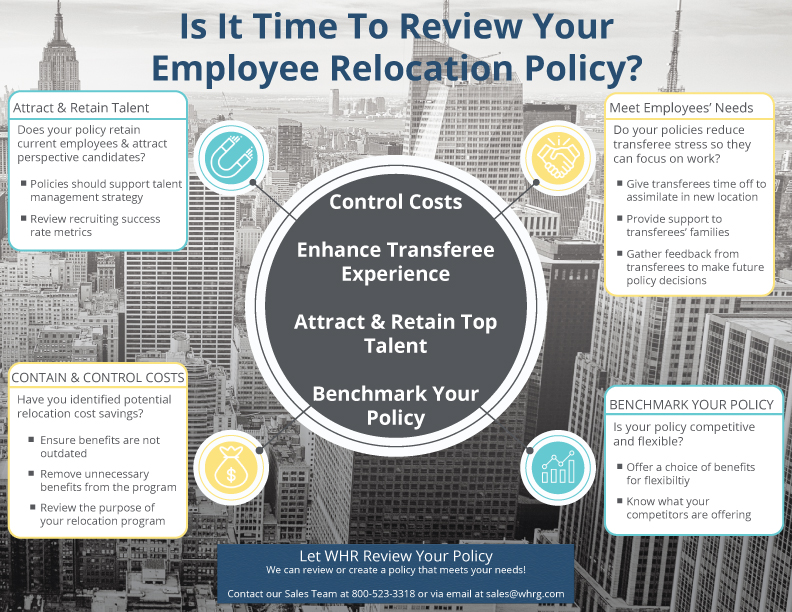
Is Your Employee Relocation Program Helping You Attract and Retain Top Talent?

There’s a talent shortage. Of course, you already knew that! With competition so high for skilled workers, it’s even more important your talent management strategy includes a solid relocation program that helps attract and retain top talent. Some organizations view relocation simply as a cost center and do not incorporate it into their talent management strategy. This can be a big mistake!

domestic relocation

You might be putting lots of effort and resources into attracting, engaging and retaining top talent, but if you’re not incorporating it into your relocation initiatives you may be missing out on a valuable talent pool. It’s important that your transferees relocate with the least amount of disruption to their work and personal lives. Whether they are new employees or existing, the right relocation policy will help transferees navigate this process and help you secure and retain your most important asset.

How a Comprehensive Relocation Program Helps Your Organization

It’s about relocation policies in the context of today’s workers, evaluating their family situations and customizing policies that will address their specific needs, all while providing the maximum benefit to your organization:

  • Move transferees as quickly as possible
  • Minimize disruption to transferees work roles and personal lives
  • Maintain a smooth transition to ensure the least disruption to internal work productivity
  • Save organizational expenses by managing the relocation process efficiently and effectively
  • Facilitate a diverse workforce by expanding your geographic talent search parameters
  • Minimize financial impact to transferees while maximizing benefits to your organization

Are you willing to embrace relocation and re-think mobility as a strategic solution to the talent crisis?

Our goal is to become your employee relocation guide and resource from creating and updating your policies, to matching current best practices, to full program development. Please contact us if you’d like to discuss your organizational relocation needs.