
Buyer Value Option (BVO) vs Guaranteed Buyout (GBO) Home Sale Programs. How Do they Compare?

In the realm of corporate relocation, home sale assistance programs play a crucial role in easing the transition for employees and companies alike.

Among the relocation home sale programs, the most popular options are the Buyer Value Option (BVO) and the Guaranteed Buyout Option (GBO) programs.

Each option offering distinct advantages tailored to different needs, our blog will review:

BVO vs GBO Home Sale Benefit home sale with contract

Buyer Value Option
(BVO)

In a Buyer Value Option program (BVO), the employee is responsible for listing their home for sale, with marketing assistance from the Relocation Management Company (RMC). The employee must secure an outside buyer willing to purchase the home at a fair market value. A buyer value option program provides all the tax benefits to the employer and employee, but it depends on the employee securing an outside buyer. The employee is funded their equity, if the contract is deemed valid, based on the outside offer amount. The RMC closes the sale with the buyer at a future date. In a BVO home sale scenario, home appraisals are never ordered.

Buyer value options are a good way for an employee to oversee the entire process and ensure the best fit for their home. The risk of the home sale falling through falls onto the employee in this home sale option.

Guaranteed Buyout Option
(GBO)

What is a Guaranteed Buyout (GBO) program and how does it differ from a Buyer Value Option (BVO)?

Under a GBO program, the RMC orders two home appraisals and then averages the two to determine a guaranteed offer, with a fixed acceptance period. If the employee cannot sell their home on their own, the employer takes the home into inventory. The employer must maintain it until the company can resell it. This carries potential risks and additional costs for an employer.

A BVO home sale, on the other hand, minimizes this risk since the employer only purchases the home after the employee has secured an outside buyer. BVO and GBO home sale programs provide tax benefits to the employer and employee.

BVO Home Sale versus GBO Home Sale

When comparing the two, the choice between BVO and GBO depends largely on the company’s risk tolerance, market conditions, and the level of support they wish to provide to their employees.

BVO programs are cost-effective for companies but can place additional burdens on employees, making them more suitable for strong housing markets.

Conversely, GBO programs, while more expensive, offer greater assurance to employees, making them a preferred choice in uncertain markets or when a company prioritizes employee satisfaction and seamless relocations.
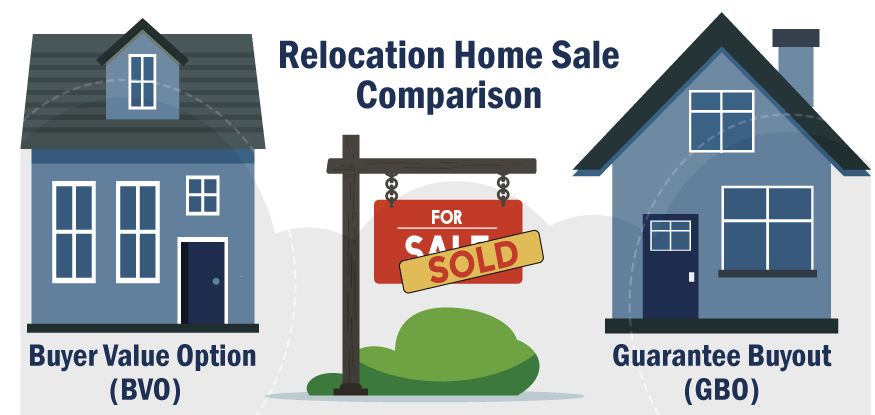
Relocation Home Sale Comparison reviews Buyer Value Option versus Guarantee Buyout Option

Here’s a side-by-side comparison of Buyer Value Option (BVO) and Guaranteed Buyout Option (GBO) home sale programs

Program Structure
Risk to Employee
Risk to Company
Home Sale Timeline
Employee Involvement
Financial Considerations
Market Impact
Flexibility
Appeal to Employees
Usage
Buyer Value Option (BVO)
Employee secures an outside buyer before the company purchases the home
Low risk if the home is sold quickly; however, the employee bears the risk if the market is slow
Lower financial risk since the company only purchases the home after an offer is secured
Typically, longer as the employee must find a buyer before the company purchase
High, as the employee is responsible for marketing and negotiating the sale of their home
Costs are generally lower for the company, but the process can be more stressful for the employee
The success of the BVO depends heavily on the current housing market
More flexible for companies that prefer to minimize upfront financial commitment
May be less attractive to employees due to potential delays and uncertainties
Preferred in stable or strong housing markets where homes are likely to sell quickly
Guaranteed Buyout Option (GBO)
Company provides a guaranteed buyout offer to the employee before listing
No risk to the employee as the company guarantees a buyout, regardless of market conditions
Higher financial risk for the company as they commit to buying the home regardless of market conditions
Generally faster, as the company buys the home directly if it doesn't sell within a set period
Lower, as the company takes over the home sale process after providing the buyout offer
Higher costs for the company due to the guaranteed purchase but provides more certainty and support for the employee
The GBO is less impacted by market conditions as the company assumes the risk
Less flexible due to the company’s financial commitment but provides more stability for employees
Generally, more appealing to employees due to the certainty and reduced personal risk
Often used in slower or volatile markets where securing a buyer may be difficult

Our countless years of BVO and GBO Home Sales experience can help you better navigate your journey.

This can include the range of tax implications, relocation variables, benefit payouts/amounts, and marketing work.

Let the experts at WHR Global help you with your BVO or GBO home sale relocation
and other global mobility program needs

WHR Global,a leader in global mobility, is an independent, full-service relocation management company with offices in the US, Switzerland, and Singapore. WHR strives to offer cost-effective relocation benefits without compromising empathy, ethics, or service

U.S. Domestic Relocation Cost Estimator

US Domestic Relocation Cost Estimator Icon

Interactive Repayment Agreement

Interactive Repayment Agreement Icon

Domestic Relocation Policy Designer

Domestic Relocation-Policy Designer icon

Relocation Benchmark Comparison

Relocation Benchmark Comparison icon

RFP – Relocation Request for Proposal Generator

Relocation Request for Proposal Generator

What is a Buyer Value Option (BVO) Home Sale Program?

A BVO home sale program is a program which is designed to help relocating employees sell their homes quickly and efficiently without the company taking ownership of the property.

According to WHR’s 2024 Global Mobility Benchmark, a BVO program remains one of the most competitive relocation offerings.

  • 60% of respondents offer home sale and/or purchase benefits.
    • Of those,
      • 59% offer BVOs to new hire non-executives
      • 78% offer BVOs to new hire executives
      • 67% offer BVOs to existing employee non-executives
      • 74% offer BVOs to existing employee executives

The best way to describe a BVO is in the context of
a traditional Guaranteed Buyout (GBO) program

Under a GBO, the relocation management company (RMC) orders two home appraisals and simply averages the two to determine a guaranteed offer.
As an example:

  • Appraiser A values a relocating employee’s home at $330,000
  • Appraiser B values the same home at $335,000
  • $332,500 is considered the “GBO”

The relocating employee then takes the offer of $332,500 and moves to their new location, unencumbered by their former home. In turn, the RMC sells the property on the
open market, and the employer is charged for all of the associated real estate expenses upon the conclusion of the sale.

The employer can treat the home sale costs as “business expenses,” so none of the expenses are considered income to the employee (for federal tax purposes).
This process is validated by the IRS in Revenue Ruling (2005-74), which specifically addresses this type of home sale program.

What is a Buyer Value Option (BVO)?

Essentially, BVO is very similar to a GBO, with the exception that with a BVO home sale program, no appraisals are completed. Instead, the buyout offer is based on a bona fide fair market offer received by the employee from a qualified third-party buyer. With BVO, the employee is responsible for listing their home for sale, and receives marketing assistance from the RMC.  

Once a contract is deemed valid, the RMC offers to buy the home from the employee at a price based on the outside sale price, and the employee is funded their equity based on this amount. The RMC will enter into a new listing agreement with the employee’s broker and proceed to close the transaction with the outside buyer while honoring all agreed terms and conditions. All home sale costs are treated in the same manner as with a GBO program.  

The BVO home sale program provides all the tax benefits to both the employer and employee. However, it is the responsibility of the employee to secure an outside buyer ready, willing, and able to purchase the property at a fair market value. 

Why should you offer your relocating employees a BVO?

    • Tax Savings: A properly structured BVO program that adheres to IRS requirements provides significant tax savings that benefit employees as well as employers.
    • Minimized Risk for Employees: Employees avoid the financial risk and stress of carrying two mortgages if they have to move before their home is sold.
    • Expedited Relocation: Employees can move to their new location more quickly, knowing that their home sale is being managed.
    • Cost Efficiency for Employers: Employers can manage relocation costs more effectively and help maintain employee productivity by reducing the stress and financial burden associated with home selling.

WHR Global provides the following
BVO support to help your employee
sell the home to an outside buyer:

    • Obtain two Broker Price Opinions (Broker Market Analyses)
    • Reconcile the two opinions of value
    • Suggest a listing price
    • Develop a comprehensive marketing strategy
    • Obtain pictures of the home
    • Provide tips to paint, declutter, etc.
    • Assist with Realtor selection
    • Obtain weekly feedback from Realtor
    • Assist in contract negotiation

Be aware: From a cost standpoint, when selling a home, the following expenditures are typical in a home sale transaction. 

When selling a home, there are several expenditures in a typical home sale transaction
  • Real Estate Commissions
  • Recording Fees
  • Transfer Taxes
  • Title Expenses
  • Notary
  • Escrow Fees
  • Seller Concessions
  • Repairs
  • Inspections
  • Miscellaneous

A Buyer Value Option home sale program is a valuable tool for companies looking to support their relocating employees. By assisting with the home sale process, companies can alleviate a significant source of stress for their employees, ensuring a smoother transition and enhancing overall job satisfaction.

For the company, this can translate into higher retention rates, more successful relocations, and a stronger ability to attract top talent. 

Ready to learn more about our move management services?

U.S. Domestic Relocation Cost Estimator

US Domestic Relocation Cost Estimator Icon

Interactive Repayment Agreement

Interactive Repayment Agreement Icon

Domestic Relocation Policy Designer

Domestic Relocation-Policy Designer icon

Relocation Benchmark Comparison

Relocation Benchmark Comparison icon

RFP – Relocation Request for Proposal Generator

Relocation Request for Proposal Generator

Relocation Home Sale Benefits

There are benefits to a real estate sale during a relocation. The process begins with the sale of the home. When it comes to selling a home as part of an employee relocation, corporate buyouts come in two main varieties:

  1. An appraisal
  2. An outside offer

There are other types of relocation-specific home sales, such as direct reimbursement of expenses, but these open the employee up to unnecessary taxation.

relocation benefits

More on Buyouts

A guaranteed buyout (GBO) is based on the value of two appraisals, which average a guaranteed offer to buy a relocating employee’s home. A second type of buyout, a buyer value option (BVO), offers a buyout based on an outside buyer’s offer.

In both cases, the employer would take over the financial responsibility and (sometimes) title until closing with a buyer. This allows the employee to move on to his or her new location with less of a burden and to escape taxation. This happens because the money relating to the home sale never actually passes through the employee’s hands. A real estate relocation specialist can help understand these types of offers.

Additional Home Sale Bonuses

In addition to a buyout, employers often offer add-on benefits, such as loss on sale (LOS) protection or a sale bonus. Both LOS and a sale bonus can be engineered to incentivize a home sale. The former by reducing any negative impact of a sale and the latter by “sweetening” the deal if the sale happens in a timely manner.

These benefits are not tax protected. Employees may incur a tax on these benefits if the employer does not elect to “gross up” the incentive.

Home Sale Bonus Trends

A consideration for both additional home sale benefits is the employee’s status within the company. It is not uncommon for these relocation house sale benefits to only be offered to existing employees and those in higher tiers. New hires may fall into a different policy tier altogether.

Based on our benchmarking data, the average percentage of offering relocation home sale benefits is 67.5%. A breakdown of these benefit offerings by industry is detailed below.

  • Homesale Benefit – Manufacturing Industry 33% 33%
  • Homesale Benefit – Pharmaceutical Industry 91% 91%
  • Homesale Benefit – Restaurant & Quick-Service Chains 50% 50%
  • Homesale Benefit – Insurance Industry 100% 100%
  • Homesale Benefit – Food & Beverage Manufacturing 56% 56%

Sale Bonus

In general, employers are more prone to offer a sale bonus when a GBO is involved, since there is more risk of the home not selling. This bonus is often based on the sale price (1 – 5% being the most common), but some companies will offer a flat rate instead of a percentage.

Since some employers also require a mandatory listing period before accepting a GBO, it is common to see the bonus amount decrease over this time, starting at its highest amount before the appraisals are ordered or concluded (e.g. a 4% sale bonus before appraisals, 3% within 30 days of appraisals, 2% within 60 days, and 1% within 90 days).

It is common to see the bonus expire when the buyout expires.

Loss on Sale Protection

Homes bought during the peak of the housing bubble suffered losses in many markets over the past decade. But with the housing market strengthening and stabilizing, there are fewer losses today. To counteract any possible losses during a relocation home sale, the LOS benefit comes in many shapes and sizes.

Traditionally, loss is calculated based on the amount paid for the home and does not include capital improvements. Once the loss is determined (sale price minus purchase price), employers have two choices:

  1. Cover all of it (often up to a capped amount)
  2. Cover a portion of it.

As a further breakdown, some companies offer to cover 50 – 75% of the loss, and the employee must cover the remainder. Often, we see employees pay 100% of the loss but only up to a capped amount (e.g. anywhere from $20,000 – 50,000). If the loss is greater than this cap, the employee can either pay the difference and continue to market and sell the home, or decide against selling the home entirely. Our research has shown caps up to $150,000, but amounts this high are uncommon.

On average, 49.5% of companies offer LOS benefits. A breakdown by industry is detailed below.

  • LOS Benefit – Manufacturing Industry 17.5% 17.5%
  • LOS Benefit – Pharmaceutical Industry 91% 91%
  • LOS Benefit – Restaurant & Quick-Service Chains 12.5% 12.5%
  • LOS Benefit – Insurance Industry 62% 62%
  • LOS Benefit – Food & Beverage Manufacturing 56% 56%

WHR Group can help with LOS benefits and a home sale bonus. We can help structure per tier to meet your organization’s unique needs. Insulating the business from unnecessary risk is important. Real estate and home relocation services can be tricky to navigate. Our 20 years of relocation service expertise will guide you to the right policy for your organization.