Household Goods and Storage

Moving household goods (HHG) is one of the most critical and complex components of a successful employee relocation program. It’s far more than loading items onto a truck and unloading them at the new destination. A smooth, well-coordinated move can make all the difference in transforming a relocation into a positive experience for employees, empowering them to start their new role with confidence and momentum.

Yet, not all household goods services are created equal.

Many companies that offer relocation benefits include household goods moves at all levels of employment. Still, those with experience in the process know how easily things can go wrong, such as lost or damaged items, delayed shipments, or the infamous couch that doesn’t fit through the door.

Now imagine moving across the country or internationally, while also starting a new job, selling a home, enrolling kids in school, and finding a new place to live. The stakes are high, and the stress is real. That’s why partnering with a relocation management company like WHR is essential. We help ensure a timely, secure, and cost-effective transition.

A smooth, well coordinated move includes a household goods shipments and storage relocation benefit

5 Important Factors of Offering a Household Goods Move Benefit

A full-service HHG move involves far more than packing boxes and renting a truck. Below are the most important factors to consider when offering this benefit as part of a relocation package:

1) Time and Productivity

Moving without professional support can be incredibly time-consuming and physically exhausting, especially for employees balancing job transitions. For example, it typically takes an experienced moving crew 3 to 4 days to pack and load a moderately furnished 2,000-square-foot home. Without help, that same move could take an employee weeks and often requires them to take time off work.

Additionally, most moving companies will only insure items they pack themselves. That means DIY packing could not only increase the time commitment but also the financial risk.

2) Logistics and Coordination

Long-distance or international moves involve multiple moving parts: moving crews, drivers, shipment schedules, third-party services for disassembly and reassembly of large items, storage, and more. Add in complications like delayed closing dates on a home, and it’s easy to see how things can unravel quickly.

Having a dedicated relocation partner helps ensure all these moving pieces stay in sync, so employees aren’t left managing a puzzle during an already stressful time.

Household Goods Shipment

3. Cost Management

The cost of household goods shipments has risen considerably in the past five years, driven by labor shortages, material costs, and insurance premiums. See our white paper “The Rising Cost of Household Goods Shipments.”

HR and mobility teams must balance cost containment with service quality. Without negotiated rates or preferred supplier agreements, costs can escalate quickly. In our 2025 Global Mobility Benchmark, 49% of respondents stated that they provide coverage for all reasonable third-party services. (i.e., crating, disassembly/assembly, etc.)

Relocation providers often have pre-established relationships with moving companies, helping employers control and reduce overall spend while still providing a high-quality employee experience.

4) Storage Needs

Long-distance or international moves involve multiple moving parts: moving crews, drivers, shipment schedules, third-party services for disassembly and reassembly of large items, storage, and more. Add in complications like delayed closing dates on a home, and it’s easy to see how things can unravel quickly.

Having a dedicated relocation partner helps ensure all these moving pieces stay in sync, so employees aren’t left managing a puzzle during an already stressful time.

5) Risk and Liability

Relocating household goods comes with plenty of potential risks—from damaged furniture to lost boxes.

A formal HHG benefit should always include adequate insurance coverage and clear protocols for handling claims. Professional movers also provide detailed inventories and tracking, reducing the chance of items going missing.

Why a Household Goods Move Benefit Matters

Offering a structured, well-managed HHG move benefit helps reduce stress for your relocating employees and protects your company from delays, cost overruns, and productivity loss. It ensures your people can focus on what matters most: starting their new role with confidence and minimal disruption.

At WHR, we provide the resources, experience, and supplier partnerships to help you build a smart, cost-effective household goods policy that meets your business goals and your employees’ needs.

Ready to learn more about our move management services?

These five tools allow you to answer a few short questions about your company’s global mobility program and will send you a custom report based on your answers

U.S. Domestic Relocation Cost Estimator

US Domestic Relocation Cost Estimator Icon

Interactive Repayment Agreement

Interactive Repayment Agreement Icon

Domestic Relocation Policy Designer

Domestic Relocation-Policy Designer icon

Relocation Benchmark Comparison

Relocation Benchmark Comparison icon

RFP – Relocation Request for Proposal Generator

Relocation Request for Proposal Generator

5 Corporate Relocation Trends to Keep an Eye On | Q4 2023

Employee Relocation Abstract globe focusing on North America illustration Ai generat

Here are 5 corporate relocation trends WHR Global is keeping an eye on for Q4 and beyond!

Global Housing Costs

Verdict: ↑ Varied ↓

Whether purchasing or renting around the world, global housing costs are expensive, but the past 12 months have been inconsistent. Within the corporate relocation industry, it’s important to keep an ear to the ground in key hubs of economic activity so organizations know when to adjust housing allowances, begin to offer mortgage support for homeowners, or improve the level of support. Below are examples of just a few key economic zones WHR is monitoring closely:


  • Germany: Year-over-year (YOY) property price decrease of -4%.
  • Japan: YOY property price increase of 5%.
  • Netherlands: YOY property price decrease of -9%.
  • Singapore: YOY property price increase of 7%.
  • Switzerland: YOY property price increase of 4%.
  • United Arab Emirates: YOY property price increase of 18%.

  • United States:
    • Homebuyers: average 30-year fixed mortgage rate increase from 6.02% (15-Sep-2022) to 7.18% (15-Sep-2023).
    • Boston, MA: median monthly rent increase of 3% YOY from $3,200 USD/month to $3,300 USD/month.
    • Los Angeles, CA: median monthly rent decrease of -8% YOY from $3,195 USD/month to $2,950 USD/month.
    • Houston, TX: median monthly rent remained stagnant with a 0% YOY difference from $1,794 USD/month to $1,795 USD/month.
    • New York, NY: median monthly rent increase of 5% YOY from $3,480 USD/month to $3,664 USD/month.
    • Miami, FL: median monthly rent decrease of -12% YOY from $3,800 USD/month to $3,350 USD/month.

Corporate Relocation in the Netherlands

Verdict: ↑ Trending Up ↑

Thanks to the European Union’s Right to Work and expat-friendly legislation such as the 30% facility, corporate relocation is positioned to trend upwards. For those unfamiliar, the Netherlands 30% facility allows employers to choose to pay their employees 30% of their annual salary tax-free (provided they meet certain baseline conditions). Expats also enjoy geopolitical stability, a consistently high quality of life, and expat-friendly banks such as ABN AMRO.

Netherlands Migration Statistics (2013-2022)

This chart shows immigration, emigration, and net immigration for the Netherlands from 2013-2022.

ESG Considerations in Corporate Relocation RFPs

Verdict: ↑ Trending Up ↑

Environmental Social Governance (ESG) is becoming commonplace in most corporate relocation RFPs. As organizations focus on sustainability and ethical practices, these factors play a pivotal role in their vendor selection. ESG compliance aligns with a company’s values, reflecting positively on its brand image.

Choosing corporate relocation services providers committed to these principles demonstrates a commitment to social and environmental responsibility, appealing to both employees and stakeholders. Organizations should seek out corporate relocation serivces providers who value committed action plans such as EcoVadis certifications and Science-Based Targets.

EcoVadis helps organizations manage ESG risk and compliance, meet corporate sustainability goals, and drive impact at scale by guiding the sustainability performance improvement of corporations and their supply chains.

Science-Based Targets help organizations lead the way to a zero-carbon economy, boost innovation and drive sustainable growth by setting ambitious, science-based emissions reduction targets. 

Air Shipments in Corporate Relocation

Verdict: ↓ Slightly Trending Down ↓

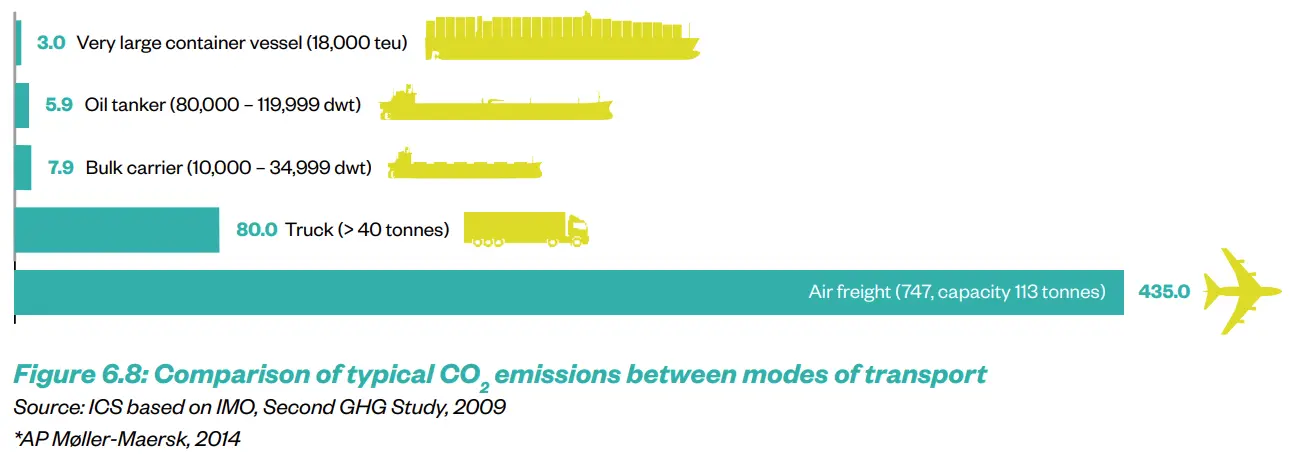
As detailed in our article, “ESG in Global Mobility: Turning the Tide on Air Shipments,” there are significant ESG advantages to reducing or eliminating air shipments. Air shipments have long been the go-to choice for international relocations and corporate moves due to their speed and efficiency. However, the environmental impact of air cargo emissions cannot be overlooked. As a greener alternative, sea container shipments present a compelling case for global mobility programs to transition towards more eco-friendly transportation modes.

To compare typical CO2 emissions between modes of transport (measured in grams of CO2 per metric ton of goods shipped per mile): flights emit 500 grams of CO2/metric ton of cargo per kilometer of transportation. However, ships emit only between 10 to 40 grams of CO2 per kilometer.

Communicate the difference in CO2 emissions between air, road, and sea shipments. Your employees may self-select a more eco-friendly option (if feasible), sending fewer items in their air shipments or not utilizing them at all. Or, instead of an LDN air shipment container which has a weight capacity of 750 lbs, consider reducing this entitlement to a D air shipment container which has a weight capacity of approximately 500 lbs.

Implement programs such as Discard & Donate to reduce shipment sizes, thereby reducing organizational costs and CO2 emissions. Consider offering a cash allowance in lieu of the air shipment, or eliminate the air shipment option altogether.

Global Mobility ESG

Inclusive Language in Employee Relocation Policies

Verdict: ↑ Trending Up ↑

As discussed during various regional relocation council meetings, including WiERC & CRC Chicago, corporations can have a large positive or negative impact on their employees by how their policy language is written. Writing a definition for family size, as an example, can have large downstream impacts if a family member feels excluded.

Here are some of the considerations employers should take into account when defining family size in their relocation policies:

  • Is your definition for family size consistent across all HR policies?
  • Is your relocation policy inclusive of same-sex relationships?
  • Should dependent children be limited to 18-years-old and younger? Or should dependent children include those up to 21-years-old if they’re still attending school?
  • Should your relocation policy include or exclude elderly dependents? If elderly dependents are included, this could have immigration complications.
Family moving home

Conclusion

In summary, the corporate relocation landscape is undergoing significant shifts, and WHR Global is diligently monitoring these trends for Q4 and beyond. The global housing market presents a complex and varied picture, emphasizing the need for organizations to remain adaptable and responsive in adjusting housing allowances and support mechanisms. The Netherlands emerges as a promising destination for corporate relocation, thanks to favorable legislation and expat-friendly policies. Additionally, the rise of Environmental Social Governance (ESG) considerations in relocation requests for proposals (RFPs) underscores the growing importance of sustainability and ethical practices. Finally, the focus on inclusive language in employee relocation policies highlights the impact that thoughtful policy design can have on employees’ well-being and satisfaction. As the corporate relocation landscape evolves, staying informed and embracing these trends will be crucial for organizations seeking to navigate this dynamic environment successfully.

ESG in Global Mobility: Turning the Tide on Air Shipments.

In an era where environmental, social, and corporate governance (ESG) is gaining significant traction, it is crucial for global mobility programs to evaluate and modify their transportation methods accordingly. Air shipments have long been the go-to choice for international relocations and corporate moves due to their speed and efficiency. However, the environmental impact of air cargo emissions cannot be overlooked. As a greener alternative, sea container shipments present a compelling case for global mobility programs to transition towards more eco-friendly transportation modes. In this article, we explore the advantages of sea container shipments and emphasize the need for a shift away from air shipments.

How Air Shipments Impact ESG in Global Mobility:

Air cargo plays a vital role in global trade and mobility due to its rapid delivery times and efficient logistics. However, the environmental repercussions are substantial. Aircraft emit greenhouse gases, including carbon dioxide, nitrous oxide, and particulate matter, contributing significantly to global warming and air pollution. The carbon footprint of air shipments is disproportionately high compared to other transportation modes, making it imperative for businesses and global mobility programs to seek sustainable alternatives.

The image below is a comparison of typical CO2 emissions between modes of transport (measured in grams of CO2 per metric ton of goods shipped per mile). Other sources estimate that flights emit 500 grams of CO2/metric ton of cargo per kilometer of transportation. However, ships emit only between 10 to 40 grams of CO2 per kilometer.

The Advantages of Sea Container Shipments:

Reduced carbon footprint:

Sea container shipments emit significantly lower carbon dioxide per ton-mile compared to air shipments. Large cargo vessels have higher fuel efficiency and capacity, allowing them to transport goods in bulk, thus reducing per-unit emissions. This makes sea container shipments a more environmentally friendly option, particularly for long-distance relocations.

When paired with environmentally-friendly services such as Discard & Donate, global mobility programs take their ESG commitments to the next level. Not only does Discard & Donate reduce the cost of each household goods shipment for employers, it reduces the overall carbon footprint of air, sea, and ground shipments by eliminating the transportation of unneeded items and reducing the amount of packaging materials.

Cost-effectiveness:

Sea freight is generally more cost-effective than air transportation, especially for bulky or heavy shipments. By embracing sea container shipments, global mobility programs can potentially reduce shipping expenses, allowing for more flexible budget allocations or investments in sustainable practices.

Improved packaging and consolidation:

Sea container shipments necessitate careful packaging and consolidation due to the longer transit times involved. This requirement often results in more efficient use of space, reducing the overall volume of shipments. Effective consolidation reduces the number of containers needed and maximizes the use of vessel capacity, contributing to a more sustainable supply chain.

ESG-friendly modes for last-mile delivery:

While sea container shipments are not as fast as air shipments, various sustainable last-mile delivery options, such as rail or road transport, can be utilized to bridge the gap. This multimodal approach ensures that sustainability is maintained throughout the entire logistics process, from port to final destination.

Promoting circular economy practices:

The longer transit times of sea container shipments provide an opportunity for companies and individuals to adopt circular economy principles. By embracing sustainable packaging, reusing materials, and optimizing supply chains, global mobility programs can contribute to reducing waste and promoting responsible consumption practices.

Conclusion:

As the world continues to grapple with environmental challenges, it is crucial for global mobility programs to proactively shift away from air shipments and embrace ESG-friendly transportation alternatives. Sea container shipments provide numerous advantages in terms of reduced carbon emissions, cost-effectiveness, improved packaging practices, and opportunities for circular economy practices. Global mobility programs should consider the following steps to reduce their carbon footprint:

  1. Communicate the difference in CO2 emissions between air, road, and sea shipments. Your employees may self-select a more eco-friendly option (if feasible), sending fewer items in their air shipments or not utilizing them at all.
  2. Reduce the size of the air shipments offered. Instead of an LDN air shipment container which has a weight capacity of 750 lbs, consider reducing this entitlement to a D air shipment container which has a weight capacity of approximately 500 lbs.
  3. Implement programs such as Discard & Donate to reduce shipment sizes, thereby reducing organizational costs and CO2 emissions.
  4. Offer a cash allowance in lieu of the air shipment, or eliminate the air shipment option altogether.

By transitioning to sea container shipments, global mobility programs can play an active role in minimizing their environmental impact and contributing to a greener future. Embracing sustainable shipment modes is not only an ethical responsibility but also a business imperative that aligns with the growing global focus on environmental sustainability.