The Importance of Immigration Assistance

Immigrating to a new country requires several steps, so it can often be difficult for an employ­ee to decide where to start after receiving their new international assignment.

Every country has its own immigration laws and requirements that will need to be followed for the employ­ee to have a successful relocation. Providing Immigration Assistance as a formal relocation benefit will help your employees get started on their move and, ultimately, reduce their stress throughout the process of settling in abroad.

Here are three tasks to have your employees complete immediately.

1. Applying for a Passport

All relocating family members will require passports for the upcoming move, which is why it should be the first item acquired.

A passport is necessary for travel, work visa applications, and school applications. Typically, this is the easiest document to obtain, but can take 6-8 weeks from the time of application to delivery; however, this timeframe can be expedited for an extra fee.

At WHR Group, the Relocation Counselor will en­sure the employee and family obtain passports in a timely manner and confirm any existing passports do not expire within the next year, in which case the employee will want to have them renewed to avoid any future issues.

2. Applying for a Work Visa

If your employee is going to perform any work in a new country, they will be required to have a work visa, even if it is just for a short-term assignment. This is arguably the most important document required in an international reloca­tion, since an employee’s ability to perform work depends on it. The employee should start the application process as soon as possible, as it can take weeks to months before the visa is approved (depending on the destination coun­try’s regulations).

The following documentation may be required for a work visa application but not limited to:

  • Passports for each family member
  • Birth and marriage certificates
  • Divorce/adoption papers
  • Additional passport photo(s)

3. Asking Questions

Moving abroad can seem like an overwhelming process, which is why your employee is going to have questions, especially if this is the first time they have relocated internationally. They should inform their Relocation Counselor of any questions, concerns, or fears as early in the process as possible. This will ensure the relocation company provides employee-specific consultative services by helping them better understand their benefits, new position, and what is required of them.

With the help of their Relocation Counselor, Destination Service Pro­vider, and your HR department, we aim to offer the employee a smooth transition into their new country.

How WHR Group Can Help

Our aim is to coordinate and manage this pro­cess with the relevant authorities on behalf of the employee, which is why we provide assis­tance and advice in securing visas/work per­mits through our approved partners. We work closely with these partners to provide a variety of methods to monitor, measure, and improve the quality of services delivered. During this process, we also work closely with HR units to ensure all paperwork and visas are compliant and all activity is recorded.

Find out More about the Benefits You Should Offer to Your International Assignees

The Changing “Single Point of Contact”

A recent Deloitte article has rightfully called to question the necessity (and logistical possibility) of a true single point of contact (SPOC) within the relocation management process.

Take a moment to picture the intricacies of the relocation process, especially for international relocations. In the era of customer choice, transferees are faced with more options than ever when it comes to moving across borders. Deloitte explains that a SPOC for the full length of a relocation “would have to be a bona fide specialist in customs, immigration, travel, equity, home sale, employment law, and tax, among others.”

We all know that relocating is one of the most stressful events of a person’s life, which is why it’s obvious for companies like WHR Group to want to streamline the relocation process and reduce as much stress as possible for transferees. But is one person truly capable of being the subject matter expert on topics ranging from real estate to immigration?

Rather than a SPOC, WHR Group and Deloitte make the case for finding the best point of contact in today’s diverse relocation environment: “The goal should not be one point of contact, but rather the best contacts at the right movements, working together toward a common end… Experience shows that no one single person can navigate this environment as effectively as a well-organized team.”

Think of it this way: Would you rather have your transferees counseled by someone who has some knowledge of many things, or a network of people each with expert knowledge on one thing? If you’re looking for higher service scores, lower risk, and happier employees, the answer is the latter. And while WHR agrees that subject matter experts (SMEs) are critical in the relocation process, it is also the relocation provider’s responsibility to be a provider that knows the best SMEs, in their respective fields, and brings them to the table in a single-coordinated fashion for the relocating employee.

The relocation service model should bring the right people, with the right skills, at the right time for the benefit of the relocating employee. We agree that not one person can be the subject matter expert for all services, and we need to recognize our limitations as a provider. So having a skilled network of providers working behind the SPOC is the value that a relocation management company brings (and without requiring the transferee to talk to multiple points of contact). An unparalleled supply chain is what differentiates one supplier over another.

There are two reasons why WHR Group is a proponent of having a network of specialists supporting a relocation, rather than just relying on one advocate:

1. Having specialists from different relocation functions to form one network for transferees helps avoid bias.

  • WHR Group has separate Referral, Appraisal, Inventory, and Equity departments to make sure no one person is affecting the outcome of things like the listing process and, ultimately, the home sale.

2. It frees up the main Relocation Counselor’s time for higher attention to detail while functioning as a moderator instead of a SPOC.

  • While a Relocation Associate and ancillary departments assist with relocation logistics, the Relocation Counselor is able to spend more time getting to know the transferee’s unique needs and making sure every service provided through the network of specialists is in line with those needs. This translates directly into cleaner performance and higher satisfaction.

For more information on why this “network approach” is best for your transferees, read the original article here: The Emerging Model Shift in Global Talent Mobility.

Goodbye White Picket Fence: The Shifting Renter Profile

Marquette University’s Chair in Real Estate, Dr. Mark Eppli, once posed to WHR Group a hypothesis that—based on the strong emphasis on sustainability and the powerful fear created in the millennial generation while watching their parents struggle through the most recent financial crisis—the American Dream of owning a home in the suburbs is changing.

Rising Stats on Rent

The reality today is that the number of renters has significantly increased in major metros across the country, and research shows an increase in renting at almost all age groups. As Dr. Eppli alluded, some of this shift can be traced back to millennials who are cautious about putting down roots and are already strapped with debt from student loans.

But it’s not just millennials. According to a recent Harvard study, America’s Rental Housing: Expanding options for diverse and growing demand, Baby Boomers have also been inflating the demand for rental housing: either through the real estate crash that forced them to build back their credit score, or for those looking to downsize into retirement. “While households in their 20s make up the single largest share [of renters], households aged 40 and over now account for a majority of all renters.” (Harvard study)

“The decade-long surge in rental demand is unprecedented. In mid-2015, 43 million families and individuals lived in rental housing, up nearly 9 million from 2005 — the largest gain in any 10-year period on record.”

-America’s Rental Housing Study, 2015

Today’s Renter Profile

As the trend to rent has continued upward, it has put substantial pressure on the rental market and costs. The National Association of Realtors found that, while rent has risen 15 percent over a five-year period, renters’ income grew only by 11 percent. The accelerating prices require more of a worker’s salary than in the past for the same rental units. This gap also makes it nearly impossible for renters to save for a down payment to transition into a homeowner.

Interestingly, one factor that does not seem to impact homeownership is having children. Harvard’s America’s Rental Housing study shows families with children are renting just as much as individuals.

Managing the Rental Demand in Relocation

Researchers are hoping relief for high rental demand can come from supply of new construction of both multi-unit rental properties as well as single-family rental homes. The response thus far has been slow, as many builders were put out of business during the market slowdown. Luckily, more research from the National Association of Realtors found that builder confidence is up.

The best ways for employers to support their employees in this growing renter population is to realize that their profile is changing. Many will need more than a U-Haul to move their items during a relocation. Since some employees will be renting single-family homes, the lease cancellation fees can be higher, and the need for rental assistance in specific school districts is becoming more common. Employers would be wise to review the renter support they currently offer to ensure it matches the needs of the people and families they are moving.

For additional information on the changing rental market, check out the full Harvard study here: America’s Rental Housing: Expanding options for diverse and growing demand.

The Changing Talent Landscape

The “American dream” is known to include a home in the suburbs, but due to nationwide housing shortages and crippling student debt, people simply aren’t able to settle in the suburbs. (And they aren’t working there either.)
In fact, of the over 300,000 jobs created in Illinois in the past six years, nearly 90% of them were added in the Chicago metro area.

This flush of downtown talent isn’t exclusive to Chicago. Big cities across the nation are seeing a revival thanks to the large percentage of younger generations living in downtown areas.

Data reveals that more young people are living in the biggest U.S. cities than anytime since the 1970s.This makes it difficult for employers to fill open positions at their suburban headquarters as Baby Boomers are retiring.

It’s for this reason that companies are uprooting their quiet offices for higher rent but more plentiful talent in downtown office space.

Of course, not every company can afford to relocate its headquarters in order to have more local access to a larger talent pool. So, what can you do to remain a viable employer option for candidates that favor big-city living?

For those relocating to your office, add a sign-on bonus to your benefit offering. Already offer this benefit? Consider benchmarking your existing relocation policy to find other benefits to help attract talent to your area.

You also need to offer office perks that highlight a desirable workplace culture.

Younger generations value work-life balance more so than prior generations. They seek perks such as on-site cafeterias, on-site health classes or complimentary gym memberships, and flexible work schedules that allow them to work based on their energy levels versus strict start and end times.

Additional perks like mileage reimbursement can also help convince candidates that your suburban positions are worth the daily trek from the city. In fact, Wisconsin-based company Trek (located in a small suburb outside of Madison) offers an incentive to employees who bike to work.

Remote work flexibility is another value-add that many young job candidates seek. Offering even just one day per week for your employees to work remotely can help ease the idea of a commute for city-dwellers. Plus, remote work opportunities have been shown to increase employee engagement, happiness, and productivity levels.

With the bulk of today’s younger job candidates unable to save for a home in the suburbs, you need to be creative in attracting from this talent pool, especially if you’re competing with existing downtown employers.

Top 5 Destination Services for Homeowners

When relocating an existing homeowner, there are many things to keep in mind (such as selling their home, finding a new home, moving a home’s worth of goods, and usually supporting a whole family versus one relocating employee). Here are five important benefits you should provide your relocating homeowners to make sure they settle into their new destination without any hiccups.
<img alt="destination services">,<img alt="temporary living">,<img alt="employee relocation">

1. Home Purchase Assistance

One of the first things a relocating employee asks themselves is, Where will I live? This is where Home Purchase Assistance comes in. Home Purchase Assistance should include in-depth counseling—addressing relocating employees’ needs and concerns in their new location. There are specialists at relocation management companies trained to act as an objective advocate for the transferring family throughout a home search process, reviewing the real estate agent responsibilities with respect to buying a property in the destination location. This should also include reviewing different real estate “agency” representations; employee housing requirements and time limitations, including transfer date, projected move date, preferred area, community amenities, price range, size, and style of desired property; availability; commuting logistics; and any unique requirements the transferring family may have. At WHR Group, we employ Relocation Counselors who are licensed real estate salespeople, meaning true market knowledge throughout the home purchase process.

2. Rental Assistance

We understand that owning a home isn’t for everyone, especially if this relocation is not long-term for the existing homeowner. Homeowners should also receive the option to rent in their new location, and this Rental Assistance should be personalized to the relocating employee’s unique needs. Make sure your relocation company offers renters the following helpful services:
  • Area Tours: When a local/on-the-ground agent provides a “show off” or area tour to the prospective renter. This allows the renter to see various neighborhoods that could work for them; the best areas for entertainment, shopping, and dining; plus access points to public transport.
  • Guided Tours: Following a thorough needs assessment, a local agent is assigned to locate properties that best fit the renter’s needs, until the perfect place is found. Additional support for lease negotiation and financing hurdles is provided.
  • Self-Guided Tours: The renter receives online, detailed access to available rental units following a thorough needs assessment.
  • Other: Guidance for obtaining a new driver’s license and finding local grocery stores and banking institutions for opening new accounts.

3. Network Support

At WHR Group, we manage a network of over 40,000 real estate agents. All agents are interviewed and must meet certain quality criteria before inclusion in our network. Based on the relocating employee’s particular requirements, their Relocation Counselor will select a real estate agent (or agents, depending on the complexity of the market area) in the destination location to assist the employee in finding suitable housing. The Relocation Counselor furnishes the selected agent with a complete profile of the employee’s personal housing needs and community preferences. The agent will then provide an introductory packet of information about the destination area, oftentimes containing data regarding representative communities and home price ranges, community profiles, maps, state and local income tax facts, school district data, available medical services, public transportation schedules, driver’s license and registration information, moving tips, local sites and attractions, dining and entertainment guides, recreation guides, and other pertinent information on the new location.

4. Temporary Living

Corporate relocation isn’t always long-term, which is why we maintain a network of corporate or temporary housing providers and hotel chains. Offering this service allows short-term transferees to feel at home anywhere, no matter for how long. Your relocation provider should work with temporary housing providers that, at a minimum, conduct unit inspections 24 hours prior to employee arrival, supply an inspection sheet for every unit with recent photos, and provide a phone number for 24/7 emergency assistance.

5. Area Tours

Area tours are usually conducted by the selected real estate agent but coordinated by the Relocation Counselor. Based on individual lifestyle information and housing preference criteria, the destination area agent will provide the following for the relocating employee:
  • Review desirable and affordable communities and screen the available homes within a commuting radius to the new location. The Relocation Counselor will arrange for the destination agent to contact the employee and familiarize them with more detailed information about the local area.
  • The destination agent will prepare a complete home-hunting itinerary and schedule of available properties for the employee so that the transferring family is able to get acquainted with the area and see available homes on a timetable that meets their needs.
  • When a suitable home is located, the Relocation Counselor ensures that the destination agent assists the employee in preparing the proper contracts and negotiates the home purchase according to applicable laws and regulations regarding relocation home sales.
  • To enable a more informed decision by the employee, before making an offer to purchase a property, the Relocation Counselor will arrange for the destination agent to provide the employee with historical data on comparable home sale prices for the area within the previous three years.

NJRC’s 35th Anniversary Celebration

relocation management
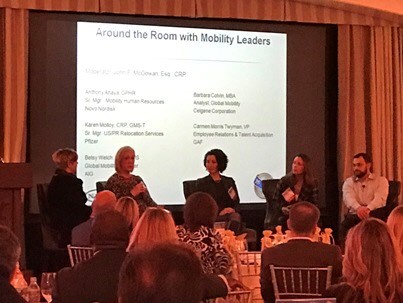
The New Jersey Relocation Council (NJRC) held its 2016 Fall Conference on Tuesday, November 15, at Fiddler’s Elbow Country Club.

WHR Group’s Director of Business Development for the Northeast Region, Kim DePinto, attended: “What a terrific conference in celebration of our thirty-fifth anniversary. We enjoyed record attendance for the sessions (132 global mobility professionals and suppliers) as well as record attendance for our corporate roundtable (35 corporate members), which was attended by Peggy Smith.”

Peggy Smith, President and CEO of Worldwide ERC®, was the keynote speaker. Peggy’s talk centered on Global Hiring Expectations, the hardest skills to find represented in today’s jobseekers, and why it’s so difficult to fill jobs with the right talent. The session also touched on new ways to find talent through apps like Roadie and TaskRabbit, and how apps like these can help fill the Generation Z need to be an entrepreneur.

Scott Michael, President and CEO of the American Moving and Storage Association, discussed new electronic monitoring for household goods drivers as well as the impact of finding unskilled laborers to train as packers in the moving industry. It will be a wait-and-see game as to how the electronic monitoring will impact delivery spreads and costs.