Relocating with Pets

Pet Relocation: A Practical Overview

Moving to a new home is a major event for the whole household, including our pets, who make it feel like home.

The good news: with a few early steps (and the right timing), you can plan your pet’s travel with confidence and care right alongside everything else on your relocation checklist. 

If you’re not sure where to start, your WHR Relocation Counselor will help you line up timing, documentation, and any approved partners you may need so pet planning stays connected to the rest of your move.

This quick guide highlights the basics and gives you a simple checklist to follow.

WHR Global supports relocation with pets

For Employees: Planning Your Pet’s Move

Whether you’re moving domestically or relocating internationally, focus on three basics: your pet’s health, destination requirements, and a flexible travel plan. Domestic moves are usually simpler, but airlines and some locations still have rules. International moves typically involve more paperwork and tighter timing.

  • Know what rules apply to your move: for domestic relocations, confirm airline requirements and local rules; for international relocations, confirm entry requirements for dogs and cats, required health certificates, and whether quarantine or a waiting period may apply
  • Talk to your veterinarian early, especially if your pet has health issues or takes medication. Ask about fitness to travel, prescription refills, and what records or medications you should keep with you during travel
  • *Note: for international travel – a specific registered Vet may be required
  • Decide on the travel approach: in-cabin when available, ground travel, or a professional pet relocation provider
  • Plan timing realistically: build in extra lead time for international paperwork and appointments, and account for any required waiting period or quarantine so your move dates stay realistic. Note: planning may need to begin several months in advance of your move
  • Confirm pet-friendly housing early: check pet policies for temporary living and your long-term home, including deposits or monthly pet fees, limits on the number of pets, weight limits, and any breed or building restrictions. If you will stay in temporary housing first, confirm pet rules at check-in
  • Investigate options for a potential return to your home country: Some countries require an extremely long lead time, up to one year, and complex process to return pets to their home location. Ie Australia. Fully investigate this at the time of departures, to be prepared in case it affects your decision to relocate them

How WHR helps:
Your WHR Relocation Counsellor can help you understand what’s covered, set a realistic timeline, and coordinate approved partners, so pet planning stays connected to the rest of your move.

Furthermore, our team has personally moved their pets internationally and has first-hand experience with the relocation process and options.

The takeaway:
Start early; minimum 90days before the move, ideally longer. Your WHR Relocation Counselor can help you keep pet requirements and move timing in sync

Quick resource tip: If you’re relocating internationally and want a simple way to double-check destination rules and timing, destination guide sites (for example, PetRelocation.com’s country pages) can help you understand typical steps, required documents, and estimated lead times before you start booking flights and vet appointments. 

Real-world example (UK entry rules):

The United Kingdom has stricter arrival rules than many destinations. Often, pets cannot arrive in the passenger cabin on UK-bound flights (service dogs are an exception) and must follow an approved route and process as manifest cargo. Because of that, some assignees choose to fly into a nearby EU city (for example, Paris or Brussels), where in-cabin travel may be permitted by the airline, and then continue into the UK by car or an approved pet shuttle/ground transport option. 

Airline pet policies and handling standards vary by carrier and route. When air travel is necessary, ask early about options (in-cabin vs. hold vs. cargo), seasonal restrictions, and how animals are handled during connections.

Depending on the season and destination, especially during summer, an evening flight may be a more comfortable option when you’re using a pet-friendly airline because cabin temperatures are often lower than they are on mid-day or afternoon departures. That can be especially helpful for pets that are sensitive to heat or weather changes. Some airlines also have specialized live-animal handling facilities (for example, Lufthansa Cargo’s Animal Lounge in Frankfurt), which can be one factor families consider when selecting routings. 

Once you’ve confirmed destination rules and flight options, the checklist below helps you keep the remaining details organized, from packing through arrival. If this feels like one more thing on an already-full list, you’re not alone; a simple plan early on can make everything go more smoothly.

Pet Move Checklist

Use the steps below as a guide to keep pet planning on track alongside the rest of your move:

  • Book a vet appointment early: make sure your pet is healthy enough to travel, confirm vaccines, refill prescriptions, and find out if you’ll need a health certificate for your route or destination. For international moves, ask whether your destination requires a specific vaccine, blood test, or treatment sequence and whether a waiting period applies before travel is allowed.
  • Confirm the rules and pick your travel approach: for moves within the U.S., double-check airline and state/local requirements. For international moves, confirm entry requirements, documents, and any waiting periods or quarantine rules. Then choose what makes the most sense for your family (in-cabin when available, ground travel, or a professional pet relocation provider).
  • Get your pet used to the carrier or crate early: leave it out at home and make it comfortable, so it feels familiar by travel day.
  • Keep routines as steady while you pack: try to stick with normal feeding, walks, and playtime, and keep favorite toys or bedding out until the end.
  • Have a moving-day safety plan: moving day can be loud and unpredictable. If possible, have your pet stay with a friend or relative. If not, set up one closed, quiet room with food, water, and a litter box (if needed), and post a clear note on the door for movers.
  • Confirm pet-friendly housing early: check policies for temporary housing and your long-term home, including deposits or monthly fees, limits on the number of pets, weight limits, and any breed or building restrictions.
  • Settle in with a “home base” and a simple care plan: set up a pet-safe zone first (one room is perfect), then expand access gradually. It’s normal for pets to act a little “off” at first, so give them a few weeks. If you can, identify a new veterinarian near your destination before you need one.

How WHR helps:
We’ll help you understand what’s covered per your employer’s policy, map out a realistic timeline, and coordinate approved partners when needed, so pet planning stays aligned with the rest of your relocation.

The takeaway:
Start early, confirm requirements, and build in a little buffer for timing. Your counselor can help you keep the pieces moving together.

For Employers: Offering Pet Relocation as a Benefit

Pet relocation support can ease employee stress and reduce last-minute disruptions when plans change. The simplest programs spell out what’s covered and give employees one clear place to get answers and guidance.

Note: Service animals are not the same as pets, and they follow different rules and documentation standards (each country may have it’s own rules). On the employer side, it’s usually best to route service animal questions through your accommodation or HR process rather than a pet relocation benefit. Calling out that difference upfront can help avoid confusion during travel planning and housing setup.

  • What is covered: guidance only, an allowance, reimbursement up to a cap, or direct-billed provider support
  • Who is eligible: which move types, which pets, and any limits on the number of pets
  • How approvals work: when pre-approval is required and who makes exception decisions
  • How employees get help: clear instructions, trusted partners, and a consistent process

How WHR helps:
WHR helps you define how pet relocation fits into your program and gives employees counselor-led guidance. We also provide visibility into common questions and exceptions, so you can keep your process consistent and adjust policy over time.

The takeaway:
Keep it clear and consistent. WHR helps connect employees with support while giving mobility teams insight into what’s being requested.

Pet Relocation: Common Questions and Helpful Resources

ReloHow do I help my pet stay calm during the move?
Keep routines as steady as possible, help your pet get used to the carrier/crate early, and use a moving day plan that limits noise and open-door risk (a trusted caregiver offsite or a closed, quiet room). If anxiety is a concern, your veterinarian can recommend options that are appropriate for your pet.

Can my pet fly in the cabin with me?
It depends on your destination, airline, route, and your pet’s size. Some flights allow small pets in-cabin in an approved carrier, while other routings require pets to travel in the hold or as cargo. The key is to confirm requirements before you book, especially for international travel.

How long will it take my pet to adjust to the new home?Keep routines as steady as possible, help your pet get used to the carrier/crate early, and use a moving day plan that limits noise and open-door risk (a trusted caregiver offsite or a closed, quiet room). If anxiety is a concern, your veterinarian can recommend options that are appropriate for your pet.

Helpful Resources:

How WHR Global Supports Relocating Employees and Their Families

Working with a Relocation Management Company (RMC) like WHR Global, can help your mobility team streamline the complex employee relocation process while controlling costs

If you manage a mobility program, consider how pet support benefits can enhance employee experience, strengthen assignment acceptance, and contribute
to a more seamless relocation process.

Relocating with pets takes more than a checklist, it requires thoughtful planning around health requirements, transportation logistics, housing considerations, and the comfort of your animal throughout the journey. From ensuring vaccinations and documentation are up to date to understanding airline policies, quarantine rules, and pet-friendly housing options, each step plays an important role in a smooth transition. For employers, providing pet-inclusive relocation support can help reduce employee stress, prevent delays, and improve overall satisfaction with the move.

Partnering with a Relocation Management Company (RMC), like WHR Global, can successfully support the entire family by coordinating essential pet-related logistics, including guidance on travel requirements, connections to pet transport specialists, and assistance with identifying pet-friendly communities and housing options. Employees stay informed, timelines remain clear, and pets can transition safely into their new home environment with minimal disruption.

If you are relocating with a pet, connect with your Relocation counselor early to discuss transportation methods, breed or size restrictions, local regulations, and settling-in strategies that support your pet’s adjustment. 

What is a Buyer Value Option (BVO) Home Sale Program?

A BVO home sale program is a program which is designed to help relocating employees sell their homes quickly and efficiently without the company taking ownership of the property.

According to WHR’s 2024 Global Mobility Benchmark, a BVO program remains one of the most competitive relocation offerings.

  • 60% of respondents offer home sale and/or purchase benefits.
    • Of those,
      • 59% offer BVOs to new hire non-executives
      • 78% offer BVOs to new hire executives
      • 67% offer BVOs to existing employee non-executives
      • 74% offer BVOs to existing employee executives

The best way to describe a BVO is in the context of
a traditional Guaranteed Buyout (GBO) program

Under a GBO, the relocation management company (RMC) orders two home appraisals and simply averages the two to determine a guaranteed offer.
As an example:

  • Appraiser A values a relocating employee’s home at $330,000
  • Appraiser B values the same home at $335,000
  • $332,500 is considered the “GBO”

The relocating employee then takes the offer of $332,500 and moves to their new location, unencumbered by their former home. In turn, the RMC sells the property on the
open market, and the employer is charged for all of the associated real estate expenses upon the conclusion of the sale.

The employer can treat the home sale costs as “business expenses,” so none of the expenses are considered income to the employee (for federal tax purposes).
This process is validated by the IRS in Revenue Ruling (2005-74), which specifically addresses this type of home sale program.

What is a Buyer Value Option (BVO)?

Essentially, BVO is very similar to a GBO, with the exception that with a BVO home sale program, no appraisals are completed. Instead, the buyout offer is based on a bona fide fair market offer received by the employee from a qualified third-party buyer. With BVO, the employee is responsible for listing their home for sale, and receives marketing assistance from the RMC.  

Once a contract is deemed valid, the RMC offers to buy the home from the employee at a price based on the outside sale price, and the employee is funded their equity based on this amount. The RMC will enter into a new listing agreement with the employee’s broker and proceed to close the transaction with the outside buyer while honoring all agreed terms and conditions. All home sale costs are treated in the same manner as with a GBO program.  

The BVO home sale program provides all the tax benefits to both the employer and employee. However, it is the responsibility of the employee to secure an outside buyer ready, willing, and able to purchase the property at a fair market value. 

Why should you offer your relocating employees a BVO?

    • Tax Savings: A properly structured BVO program that adheres to IRS requirements provides significant tax savings that benefit employees as well as employers.
    • Minimized Risk for Employees: Employees avoid the financial risk and stress of carrying two mortgages if they have to move before their home is sold.
    • Expedited Relocation: Employees can move to their new location more quickly, knowing that their home sale is being managed.
    • Cost Efficiency for Employers: Employers can manage relocation costs more effectively and help maintain employee productivity by reducing the stress and financial burden associated with home selling.

WHR Global provides the following
BVO support to help your employee
sell the home to an outside buyer:

    • Obtain two Broker Price Opinions (Broker Market Analyses)
    • Reconcile the two opinions of value
    • Suggest a listing price
    • Develop a comprehensive marketing strategy
    • Obtain pictures of the home
    • Provide tips to paint, declutter, etc.
    • Assist with Realtor selection
    • Obtain weekly feedback from Realtor
    • Assist in contract negotiation

Be aware: From a cost standpoint, when selling a home, the following expenditures are typical in a home sale transaction. 

When selling a home, there are several expenditures in a typical home sale transaction
  • Real Estate Commissions
  • Recording Fees
  • Transfer Taxes
  • Title Expenses
  • Notary
  • Escrow Fees
  • Seller Concessions
  • Repairs
  • Inspections
  • Miscellaneous

A Buyer Value Option home sale program is a valuable tool for companies looking to support their relocating employees. By assisting with the home sale process, companies can alleviate a significant source of stress for their employees, ensuring a smoother transition and enhancing overall job satisfaction.

For the company, this can translate into higher retention rates, more successful relocations, and a stronger ability to attract top talent. 

Ready to learn more about our move management services?

U.S. Domestic Relocation Cost Estimator

US Domestic Relocation Cost Estimator Icon

Interactive Repayment Agreement

Interactive Repayment Agreement Icon

Domestic Relocation Policy Designer

Domestic Relocation-Policy Designer icon

Relocation Benchmark Comparison

Relocation Benchmark Comparison icon

RFP – Relocation Request for Proposal Generator

Relocation Request for Proposal Generator

What is COLA (Cost of Living Adjustment)?

Cost of Living Adjustment (COLA) is a crucial aspect corporations consider when relocating employees or hiring talent from different geographical regions.  What is COLA? COLAs are payments designed to compensate employees for the higher cost of living they encounter in their new destination. Learn more about calculating cost of living adjustments, definition, and factors in cola payments.

Understanding Cost of Living Adjustment (COLA)

Cost of Living Allowances or Adjustments, commonly known as COLA, serve a common purpose: to bridge the gap between the cost of living in a low or moderate region and that in a higher-cost location. The employer compensates the employee based on housing, goods and services, and taxes, enabling them to maintain the same standard of living in their new area. This is the purest definition of a cola, but many nuances go into the calculation.

Calculating Cost of Living Adjustment

An accurate calculation is the foundation of a fair cost of living adjustment. Several providers offer services to calculate housing costs, goods, services, and other factors to determine the standard. The origination city’s cost index is then compared to the new town’s to identify the cost difference. Many employers have a limited number of potential locations for employee relocations, making it easier to assess cost indexes. Employers may also compare entire regions instead of individual cities for easy calculation. WHR can help our clients understand the COLA formula and make the best decision.

Factors in Calculating COLA

Employers must decide under what conditions they will offer a cost-of-living adjustment. The percentage of change in the cost of living between the locations is a critical factor in determining COLA. The question becomes, what is a standard cost of living raise? Some employers may require a cost-of-living shift greater than 3%, 5%, or 10% to provide the COLA. Those aiming to offer more generous benefits may set a lower threshold for cost-of-living changes to benefit a more significant number of employees. Every employer will determine their COLA benefits differently. The cost of living adjustment will also vary by employee and, of course, location. Many of these are case-by-case situations for COLA payments.

Duration and Payment of COLA

Once a COLA is determined to be provided, the next consideration is the duration and payment method. Traditionally, U.S. domestic COLAs are calculated once and paid as a lump sum allowance or distributed over a specified period. Companies may maintain the adjustment for an extended period to allow employees more time to adapt to their new location.

 On the other hand, international COLAs are recommended to be recalculated more frequently due to fluctuating currency rates, inflation, and other uncontrollable factors. For international assignments with pre-determined end dates, companies often offer the cost of living adjustment for the entire duration. However, if the assignment is open-ended, the company may transition the employee to the local standard of living (localizing) and discontinue the COLA after a set period.

Importance of Benchmarking

Relocation benefits can vary significantly across industries. Therefore, benchmarking your organization’s COLA policy against peers is crucial. Some industries may offer more frequent and generous COLAs, while others may not consider it at all. Understanding these variations can help determine whether a COLA adjustment or increase is needed. Ultimately, it can help you tailor your policy to meet your organization’s needs. The last piece to consider in benchmarking is understanding market rates in target relocation areas.

Conclusion

Cost of Living Adjustment is a vital tool/formula corporations use to ensure their employees can maintain the same standard of living when relocating to higher-cost locations. Companies can design worker compensation and relocation packages that attract and retain top talent by understanding the factors involved in calculating COLA and benchmarking against industry peers.

Improve your COLA benefits with our Allowances & Per Diems Benchmark.

ESG in Global Mobility: Turning the Tide on Air Shipments.

In an era where environmental, social, and corporate governance (ESG) is gaining significant traction, it is crucial for global mobility programs to evaluate and modify their transportation methods accordingly. Air shipments have long been the go-to choice for international relocations and corporate moves due to their speed and efficiency. However, the environmental impact of air cargo emissions cannot be overlooked. As a greener alternative, sea container shipments present a compelling case for global mobility programs to transition towards more eco-friendly transportation modes. In this article, we explore the advantages of sea container shipments and emphasize the need for a shift away from air shipments.

How Air Shipments Impact ESG in Global Mobility:

Air cargo plays a vital role in global trade and mobility due to its rapid delivery times and efficient logistics. However, the environmental repercussions are substantial. Aircraft emit greenhouse gases, including carbon dioxide, nitrous oxide, and particulate matter, contributing significantly to global warming and air pollution. The carbon footprint of air shipments is disproportionately high compared to other transportation modes, making it imperative for businesses and global mobility programs to seek sustainable alternatives.

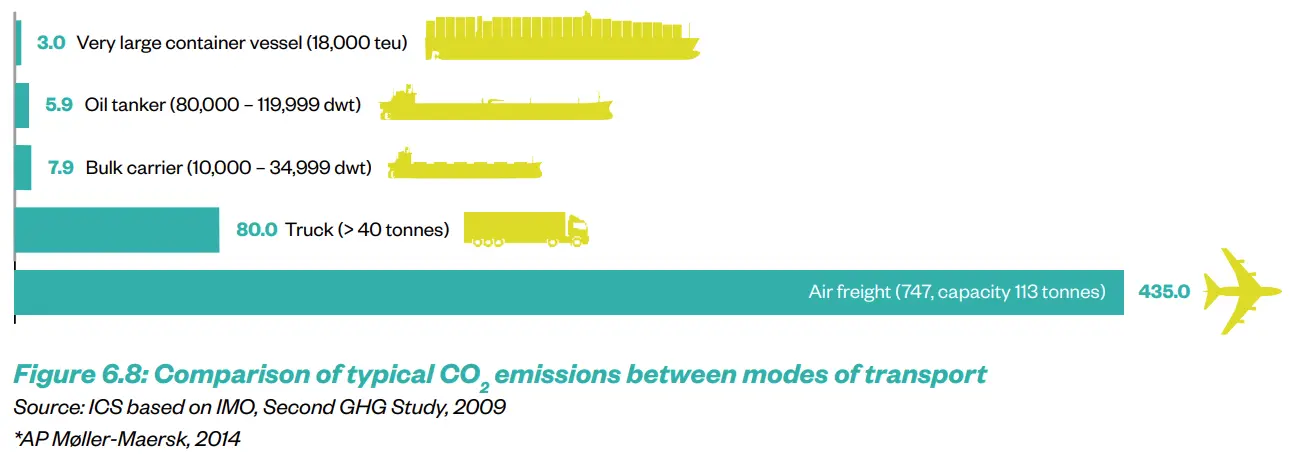
The image below is a comparison of typical CO2 emissions between modes of transport (measured in grams of CO2 per metric ton of goods shipped per mile). Other sources estimate that flights emit 500 grams of CO2/metric ton of cargo per kilometer of transportation. However, ships emit only between 10 to 40 grams of CO2 per kilometer.

The Advantages of Sea Container Shipments:

Reduced carbon footprint:

Sea container shipments emit significantly lower carbon dioxide per ton-mile compared to air shipments. Large cargo vessels have higher fuel efficiency and capacity, allowing them to transport goods in bulk, thus reducing per-unit emissions. This makes sea container shipments a more environmentally friendly option, particularly for long-distance relocations.

When paired with environmentally-friendly services such as Discard & Donate, global mobility programs take their ESG commitments to the next level. Not only does Discard & Donate reduce the cost of each household goods shipment for employers, it reduces the overall carbon footprint of air, sea, and ground shipments by eliminating the transportation of unneeded items and reducing the amount of packaging materials.

Cost-effectiveness:

Sea freight is generally more cost-effective than air transportation, especially for bulky or heavy shipments. By embracing sea container shipments, global mobility programs can potentially reduce shipping expenses, allowing for more flexible budget allocations or investments in sustainable practices.

Improved packaging and consolidation:

Sea container shipments necessitate careful packaging and consolidation due to the longer transit times involved. This requirement often results in more efficient use of space, reducing the overall volume of shipments. Effective consolidation reduces the number of containers needed and maximizes the use of vessel capacity, contributing to a more sustainable supply chain.

ESG-friendly modes for last-mile delivery:

While sea container shipments are not as fast as air shipments, various sustainable last-mile delivery options, such as rail or road transport, can be utilized to bridge the gap. This multimodal approach ensures that sustainability is maintained throughout the entire logistics process, from port to final destination.

Promoting circular economy practices:

The longer transit times of sea container shipments provide an opportunity for companies and individuals to adopt circular economy principles. By embracing sustainable packaging, reusing materials, and optimizing supply chains, global mobility programs can contribute to reducing waste and promoting responsible consumption practices.

Conclusion:

As the world continues to grapple with environmental challenges, it is crucial for global mobility programs to proactively shift away from air shipments and embrace ESG-friendly transportation alternatives. Sea container shipments provide numerous advantages in terms of reduced carbon emissions, cost-effectiveness, improved packaging practices, and opportunities for circular economy practices. Global mobility programs should consider the following steps to reduce their carbon footprint:

  1. Communicate the difference in CO2 emissions between air, road, and sea shipments. Your employees may self-select a more eco-friendly option (if feasible), sending fewer items in their air shipments or not utilizing them at all.
  2. Reduce the size of the air shipments offered. Instead of an LDN air shipment container which has a weight capacity of 750 lbs, consider reducing this entitlement to a D air shipment container which has a weight capacity of approximately 500 lbs.
  3. Implement programs such as Discard & Donate to reduce shipment sizes, thereby reducing organizational costs and CO2 emissions.
  4. Offer a cash allowance in lieu of the air shipment, or eliminate the air shipment option altogether.

By transitioning to sea container shipments, global mobility programs can play an active role in minimizing their environmental impact and contributing to a greener future. Embracing sustainable shipment modes is not only an ethical responsibility but also a business imperative that aligns with the growing global focus on environmental sustainability.

Corporate Culture & Your Relocation Program

Corporate Culture refers to the beliefs and behaviors that determine how a company’s employees and its management interact and handle business. Corporate culture is often implied, rather than expressed or defined, and it is something that develops organically over time. A company’s culture reveal itself in a variety of ways from dress code to the treatment of clients.

We’ve seen the results when relocation policies and programs match corporate culture and wanted to see how other companies stack up. That’s why we surveyed some of the largest and most successful companies around the world to participate in the 2018 Mobility + Culture benchmark study. Our unique Culture Guide analyzes each respondent’s cultural values through eight A/B style questions.

employee relocation

Do you prefer your partners to be High Tech or High Touch?

Is your company’s primary focus on technological advances or on relationship building? Of companies surveyed, 85% prefer to partner with high-touch companies. At WHR Group, we understand that relocating can be stressful on the transferee and their family. We heavily rely on the relationships that we build with our clients and their employees so that we can assist and help them to move forward in the best way possible.

While relationships and person-to-person communication is large component to how WHR handles relocation, technology is the tool that allows us to bring every factor included in the relocation to one destination. Our business is based on a “high-tech, human-touch” model, where we blend our intelligent, proprietary relocation technology with a dedicated team of real estate licensed relocation experts.

Do you primarily focus on budget or employee satisfaction?

When asking companies if they are primarily focused on budget or employee satisfaction, only 13% reported that there is more concern about budget. It’s clear that surveyed companies also understand the stressful nature of relocation and have placed their importance on employee satisfaction in their programs.

At WHR, we also value our employees. This is realized through our 5-time award winning culture in the Top Workplaces program by the Milwaukee Journal Sentinel. By hiring based off of WHR’s core values, we are able to guarantee the best service you will ever experience, regardless of the industry. Our inherently empathetic employees create high-touch relationships with transferring employees, creating a stress-free relocation experience.

Is your program designed to be proactive or reactive?

Being a “proactive” company means that the corporation actively plans ahead, and they are preparing for the needs of their employees. Of companies surveyed, 67% of them related to this culture. At WHR Group, one of our core values is to be proactive, and this is executed every day. When a transferee’s file is initiated, a call is made within 24-hours to introduce the Counseling team, and to explain what the employee can expect throughout the life cycle of the relocation. The initial call is a critical time to reveal any potential issues, set expectations, and lay the foundation for a smooth relocation.

At WHR Group, we place the utmost importance on culture as it relates to your relocation or mobility programs. We believe this goes hand in hand with our dedication to advancing lives forward.

See how WHR Group has became a leader in the global mobility industry with these 6 policies.